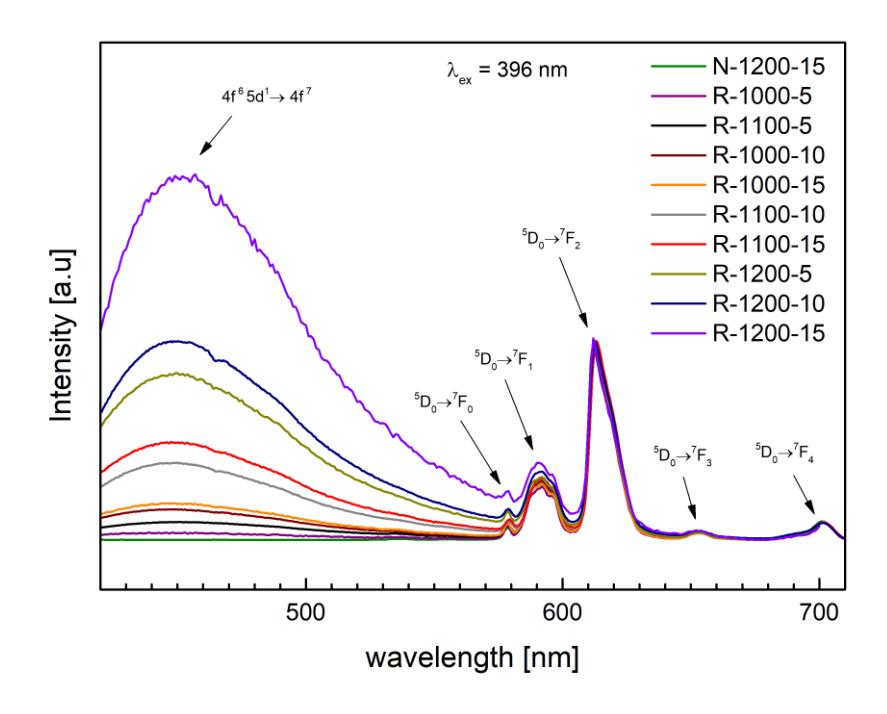
It is well known that the photoluminescence (PL) of lanthanides centers in inorganic matrices depends on their oxidation states. Therefore, it is desirable to control that factor at the stage of synthesis of the PL materials which can be promising phosphors in many applications. The experience of our group with controlling the oxidation states of transition metals present in prospective glassy and nanostructured cathode materials for Li-ion and Na-ion [1], has helped us to use similar methods to take control of the oxidation states of lanthanides centers embedded in transparent glassy matrices. Lanthanides are widely used in today's technology and this is due to a large variety of their 4f configurations of electrons in Ln atoms, which leads to a wide range of fluorescent states and wavelengths [2, 3].
Our recent work [4] proved that it is possible to synthesize Eu-doped glassy materials whose photoluminescence spectra can be tuned depending on synthesis conditions by using melt-quenching process. During that work, we found out that one can control the relative Eu3+/Eu2+ ions concentrations. However, further studies are needed to improve this method of europium ion reduction and to specify the exact influence of melting time and temperature on the final properties of the samples.
In order to do that, a series of glassy matrices (10 samples in total) with nominal composition Na3Al2(PO4)2F3 doped with 1 wt% of Eu2O3 were successfully synthesized by a melt-quenching process, using a double crucible method [5] – 9 samples, and 1 sample without reducing atmosphere. Samples synthesis condition differed, temperature was controlled in the range of 1000 °C, 1100 °C and 1200 °C and time was set as 5 min, 10 min or 15 min. Obtained glasses were carefully investigated using X-ray diffractometry (XRD), photoluminescence spectroscopy (PL) – Fig. 1, photoluminescence excitation (PLE) and absorption spectroscopy.