Cancer remains as one of the major health concerns due to its high incidence, mortality and morbidity, being the second cause of mortality in the world and accounting for 25% of all deaths in developed countries [1]. The incidence of this disease is rapidly growing, with over 18 million new cases globally reported each year [2]. For these reasons, considerable efforts are currently devoted to increase the quality of life and survival expectancy for patients by improving prevention, diagnosis and treatment for cancer diseases.
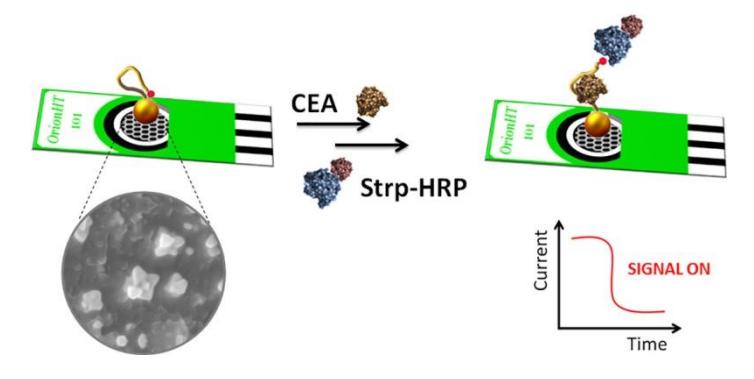
This work describes the construction of a novel amperometric aptasensor for the highly specific detection of carcinoembryonic antigen (CEA) (Fig. 1). The sensing interface was assembled by electrodeposition of reduced graphene oxide and gold nanoparticles on a carbon screen-printed electrode, and further functionalization with a biotin and thiol-modified anti-CEA DNA hairpin aptamer. The sensing approach relies on the specific recognition of CEA by the folded aptamer, causing unfolding of the DNA hairpin structure and unmasking the biotin residues at the aptamer chain. Further incubation with a sptreptavidin-peroxidase conjugate (Strp-HRP) allows the amperometric detection of the cancer biomarker. This aptasensor was able to detect CEA in the broad range from 20 pg mL-1 to 2 μg mL-1 (112 fM–11 μM) with a detection limit of 16 pg mL-1 (90 fM). The aptasensor also showed high reproducibility, specificity and stability, and was successfully validated in diluted human serum samples.