
Aggregation of $\alpha$-synuclein ($\alpha$-Syn) leading to dopaminergic neuronal death and chronic neuroinflammation has been identified as the main hallmark of Parkinson's disease (PD). Recently, another pro-inflammatory and highly amyloidogenic protein S100A9 has been indicated to be involved in PD pathogenesis, as both proteins were found co-localized and co-aggregated in Lewy bodies in PD patients [1]. Although a few studies suggest that S100A9 changes the aggregation kinetics of $\alpha$-Syn [1,2] and stabilizes certain amyloid fibril structures [2], the exact mechanisms of co-aggregation, cytotoxicity and synergistic effects remain yet to be discovered.
$\alpha$-Syn monomers might produce aggregates in a dose- and time-dependent manner in vitro and formed oligomers can vary in molecular weight, structure, size, and therefore might have a different impact on cells [3]. Here, we aimed to investigate whether extracellular recombinant $\alpha$-Syn and S100A9 in various aggregated forms induce neurotoxicity and have synergistic effect on primary cultures of rat brain neurons and glial cells.
Neuronal-glial cell cultures (NGC) were prepared from the cerebellum of 5-7 days old Wistar rat pups and incubated for 7 days in vitro. Subsequently, cells were exposed to different concentrations (0.5, 1.5 and 2.5 μM) and various pre-incubation times (30 min, 6 and 24 h at room temperature (RT)) of $\alpha$-Syn and S100A9 proteins separately or together for 48 h. Cell number and viability were assessed using light and fluorescence microscopy. All quantifications were performed using ImageJ program. Additionally, the ELISA method was used to evaluate the concentration of the pro-inflammatory cytokine TNF-$\alpha$ released in the culture growth medium after exposing cells to $\alpha$-Syn and S100A9 mixtures for 48 h. Human recombinant proteins $\alpha$-Syn and S100A9 were produced at Vilnius University.
Interestingly, we found that S100A9 aggregates were more toxic to neurons than those of $\alpha$-Syn and induced death of neurons at micromolar concentration after 48 h. While studying the synergistic effect of $\alpha$-Syn and S100A9, we revealed that mixture of both proteins pre-incubated together for 30 min at RT, resulted in microglia proliferation but did not affect neuronal viability nor the number of neurons in NGC after 48 h. By contrast, mixtures of $\alpha$-Syn and S100A9 pre-incubated for 6 h at RT strongly decreased neuronal viability in a dose-dependent manner (Fig. 1). Finally, pre-incubation of mixtures of both proteins for 24 h at RT had no effect on cell viability and number after 48 h. However, solution of $\alpha$-Syn + S100A9 induced a considerable increase of TNF-$\alpha$ concentration in cell growth medium.
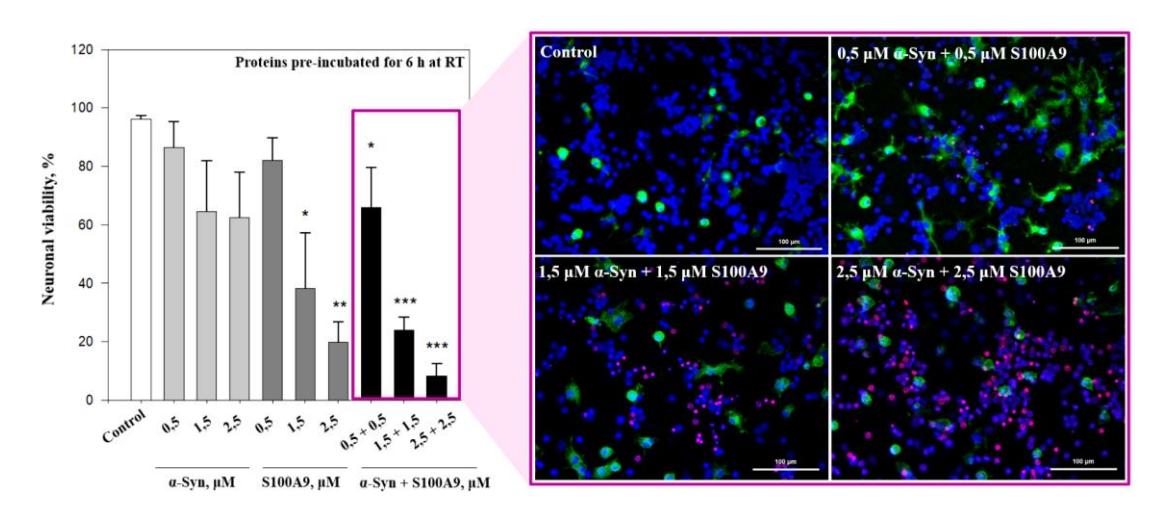
In conclusion, our results show that $\alpha$-Syn and S100A9 act synergistically, and the impact on NGC depends on protein preincubation time and concentration. Further research of $\alpha$-synuclein and S100A9 neurotoxicity mechanism is needed to gain more insight into PD pathology, and eventually to develop effective therapeutics.