Hybrid organic-inorganic polymers are widely used for the fabrication of photonic crystals, metamaterials or micro-optical components using two-photon polymerization and deep UV lithography techniques [1]. The demand for deposit coatings on 3D structures is growing and it is necessary to find alternatives to conventional physical vapor deposition technologies that are not capable to fabricate conformal coatings on 3D components [2]. Atomic layer deposition (ALD) is a promising thin film deposition technique because of strict control of the growth rate and the opportunity to fabricate coating on complex structure substrates. The principle of ALD is the formation of an atomic layer per one ALD cycle during self-limiting surface exchange reactions [3].
Hybrid polymer SZ2080TM is used for the fabrication of micro-optical components using the two-photon polymerization technique [4]. SZ2080 is synthesized mainly from methacryloxypropyl trimethoxysilane (MAPTMS) and zirconium propoxide (ZPO) precursors. In this work we present thin films grown on SZ2080 surface using the atomic layer deposition technique. Growth dynamics of the aluminium oxide on SZ2080 were investigated using quartz crystal microbalance. Linear growth begins after 10 cycles.
Trimethylaluminum and tetrakis(dimethylamino)titanium were used as precursors and oxygen plasma was used as a reactant. Aluminium oxide and titanium oxide singlelayer coatings were synthesized at 60 °C. The refractive indices and optical losses of the manufactured Al2O3 and TiO2 films were evaluated from the transmittance spectra of thin single layers and used for the numerical design of the anti-reflective (AR) optical coating.
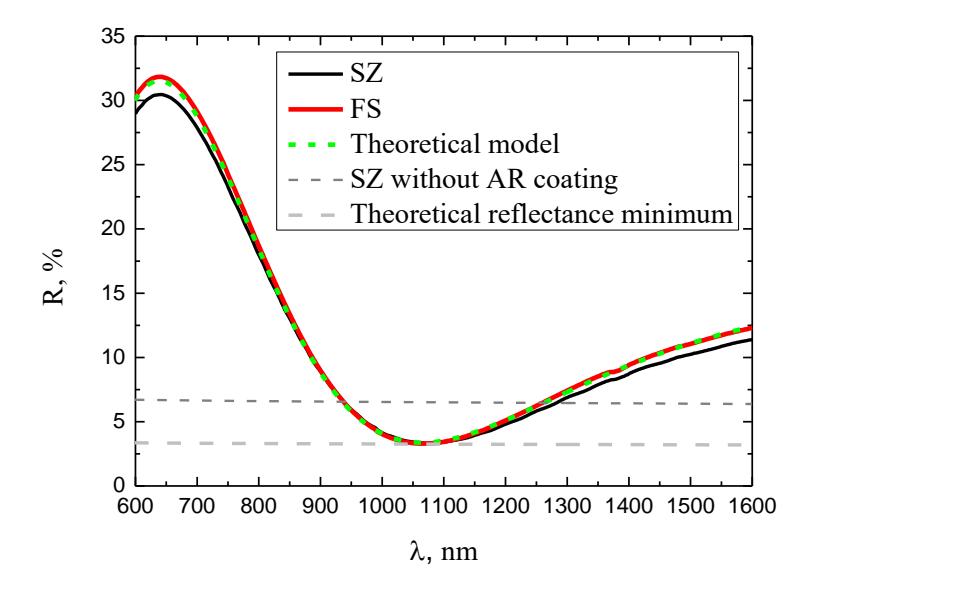
To achieve a low reflectance R < 0.1 % at the wavelength of 1064 nm, TiO2 was used as the high refractive index material while Al2O3 was used as the low refractive index material. The final structure was fabricated and analyzed. Experimental measurements are in good agreement with theoretical simulations (see Fig. 1). The coating decreases the reflection from 3.3 % to 0.1 % at the wavelength of 1064 nm for one surface of SZ2080 layer without any visible cracks or destructive deformations. In perspective, this is the first step toward technologically viable applications.