Methyl group is one of the simplest functional groups in chemistry, making it an abundant motif of organic and hybrid materials. At low temperature, methyl group acts as a quantum rotor, which exhibits quantum tunneling. Recently, for the first time, a quantum tunneling of methyl group was observed using pulsed Electron Paramagnetic Resonance (EPR) spectroscopy in Mn2+-doped [(CH3)2NH2][Zn(HCOO)3] (DMAZn:Mn) hybrid perovskite [1]. Despite this study, many unsolved problems remain regarding the applicability of pulsed EPR spectroscopy in observation and description of methyl group tunneling in hybrid and other materials.
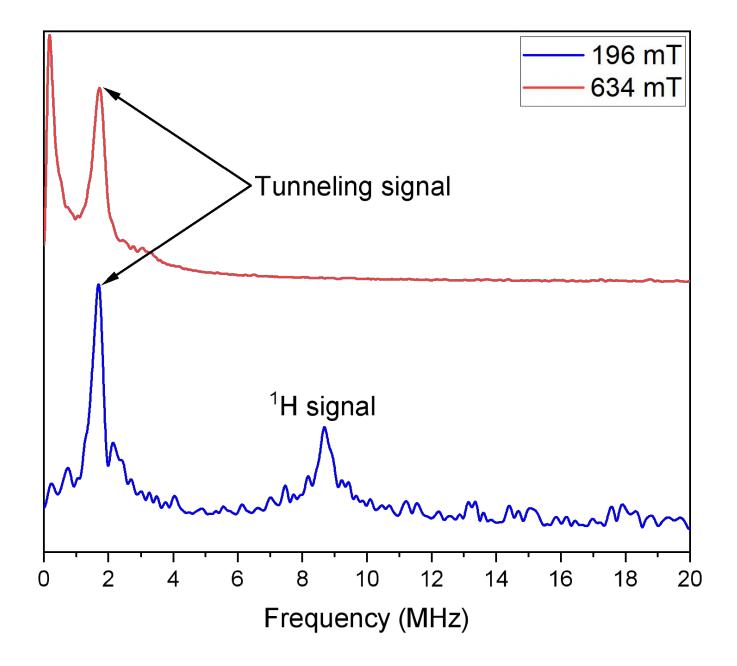
In this work, we study the methyl group tunneling in Co2+-doped [(CH3)2NH2][Zn(HCOO)3 (DMAZn:Co) hybrid perovskite by using pulsed Electron Spin Echo Envelope Modulation (ESEEM) spectroscopy. By comparing our results with DMAZn:Mn, we investigate how different paramagnetic dopants affect the rotation barrier and thus the methyl group tunneling.