
Pain is a peculiar psychophysiological state of a human, which arises due to the influence of excessive stimuli, which cause organic or functional disorders in the body. Effective treatment of pain eliminates physical suffering, stress, facilitates the work of the heart and lungs, reduces the risk of venous thrombosis and helps to normalize digestion [1].
Despite the achievements of modern local anesthesia, novocaine remains the standard analgesic in clinical practice. Being a weak base, it blocks Na+ channels, prevents the generation of impulses in the endings of sensitive nerves and the conduction of impulses through nerve fibers. It changes the potential of action in the membranes of nerve cells without a pronounced effect on the resting potential, suppresses the conduction of pain and mechanical impulses. When absorbed and entering the bloodstream, it reduces the excitability of peripheral cholinergic systems, reduces the formation and release of acetylcholine from the preganglionic extremities (has some ganglioblocking action), eliminates spasm of smooth muscles [2] and reduces excitability.
When administered parenterally, novocaine is well absorbed and rapidly hydrolyzed in the bloodstream under the action of two types of cholinesterases: acetylcholinesterase and butyrylcholinesterase to paraaminobenzoic acid and diethylaminoethanol. Cholinesterase inhibitors were added to the analgesic drug to prolong the action of novocaine. Polyphenolic compounds from the group of flavonoids, which are known to have antioprotective, antioxidant, anti-inflammatory and immunomodulatory properties, were considered inhibitors. As potential analgesics, flavonoids suppress inflammatory processes, oncological diseases, progress of neuropathic conditions. As a result, silibinin was chosen due to its high bioavailability and low toxicity.
The following methods were used during the study: bibliometric, empirical, mathematical. Kinetic studies were performed using the spectrophotometric method using a UV spectrophotometer SPECORD 200 (Analytic Jena, Germany).
When silibinin is introduced into the reaction mixture, the rate of hydrolysis of novocaine by butyrylcholinesterase is reduced. The rate constant of the first order when adding 100 μm of silibinin to the system decreased from $1.26\pm0.07\times10^{-3}$ c-1 to $0.76\pm0.07\times10^{-3}$ c-1, which confirms the inhibitory properties of flavonoids. At concentrations of silibinin in the system of 25, 50 μm, the rate constant decreases by 1.2 and 1.4 times, respectively.
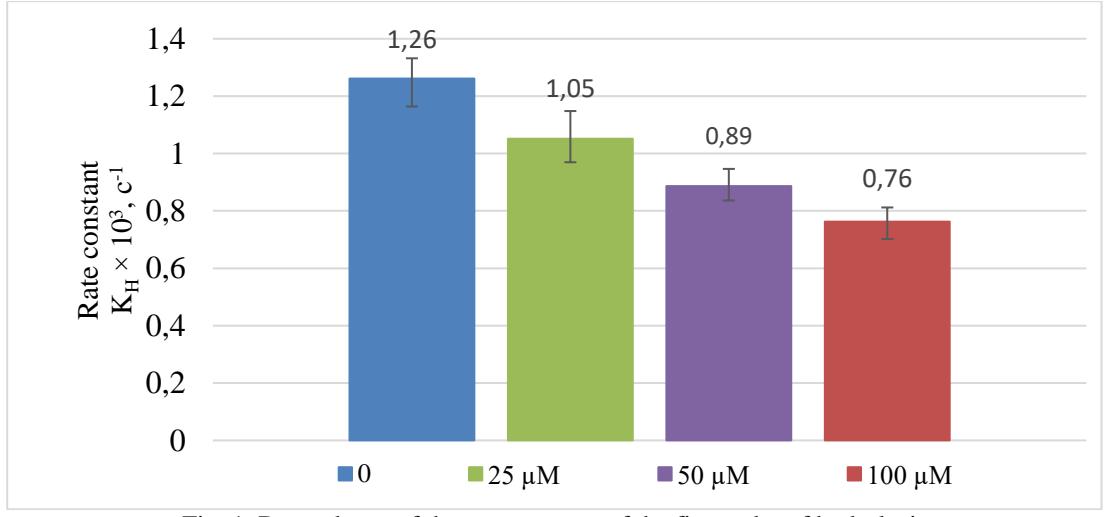
The study found that silibinin effectively inhibits human serum butyrylcholinesterase. Thus, the development of a prolonged-release analgesic drug based on novocaine with the addition of silibinin to prolong the analgesic effect is promising.