European governments have been encouraging drivers to buy diesel vehicles rather than gasoline-powered ones since the 1990s. The reason for this was higher diesel fuel efficiency and lower CO2 emissions in diesel exhaust, although it emits higher levels of particulates including black carbon (BC) [1]. In IPCC report Global Warming 1.5 °C black carbon (BC) was presented as the only component of aerosol particles that has a positive effect on atmospheric thermal balance [2]. Moreover, BC raises a threat to air quality and human health. Due to the formation during combustion processes, BC aerosol particles are small (around 200 nm) with porous surface and can adsorb various combustion-derived toxic compounds. Due to small radius, the particles can penetrate through lungs into other organs and cause serious health problems such as DNA damage, oxidative stress, pneumonia [3]. Currently there are no regulatory terms which control BC mass concentration levels. However, it is crucial to identify prevailing BC sources and develop mitigation strategies for the purpose of improving air quality and minimizing personal exposure of the public to atmospheric pollutants.
In this study the measurements were deployed in Vilnius (urban background site) using an Aerosol Chemical Speciation Monitor (ACSM) (Aerodyne Research Inc., USA) and a 7-wavelength Aethalometer (Model AE31 Spectrum, manufactured by Optotek, Slovenia). Aethalometer model was used to determine the quantitative contribution of fossil fuel and biomass combustion to the mass concentration of black carbon aerosol particles. This model uses source-specific absorption Angstrom exponent (AAE) values, which depend on various site-specific parameters, such as: common sources of pollution, fuels used, meteorology [4]. Therefore, the determination of individual values of the AAE for the urban environment is important in order to perform a qualitative separation of the origin of sources and to assess the contribution of pollution sources.
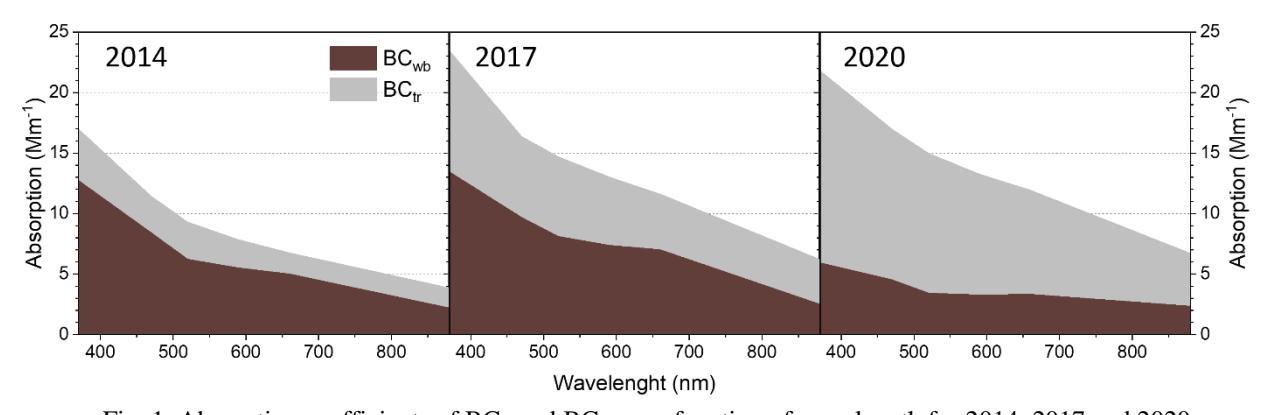
The study provides a quantitative assessment of pollution associated with diesel vehicles and points out that from 2014 to 2020 with an increase in the number of diesel vehicles of as much as 83.9%, a 1.3-fold increase in BCtr (transport-related BC emission) mass concentration and 3.6-fold increase in BCtr light absorption coefficient. Furthermore, a combination of the most suitable AAEtr and AAEwb (for transport exhaust and biomass burning emission, respectively) values for urban background environment was statistically established based on the correlation criteria between BC and trace pollutants. Regarding the negative impacts of BC on human health and the thermal balance of the atmosphere, the results of this study address air quality issues and seek possible measures to combat air pollution.