
Electrochemical water dissociation involves two reactions: the hydrogen evolution reaction (HER) and the oxygen evolution reaction (OER), at the cathode and anode, respectively [1].
Water electrolysis could be sustainable and clean production of hydrogen as fuel, but HER and OER rates need to be improved for industrial applications. The OER involves the transport of four electrons which requires a high overvoltage to reach a satisfactory current density [1].
OER: $$4OH^{-} \rightarrow 2H_{2}O + O_{2} + 4e^{-}$$
Numerous studies have been focused on synthesizing high-performance and low-cost anode materials [2]. Metal oxides and metal chalcogenides are recognized as promising electrocatalysts for OER [3]. They can be synthesized using various methods with a wide range of precursors.
Herein cobalt (III) oxide (Co3O4) and cobalt (III) oxide combined with tin oxide (Co3O4/SnO2) were examined for OER in alkaline media by linear sweep voltammetry (LSV). A three-electrode system was used for electrochemical examination where saturated calomel electrode (SCE) and graphite rod were set as reference and counter electrodes, while Co3O4 and Co3O4/SnO2 were used as the working electrodes. All potentials in this paper were given versus reversible hydrogen electrode (RHE).
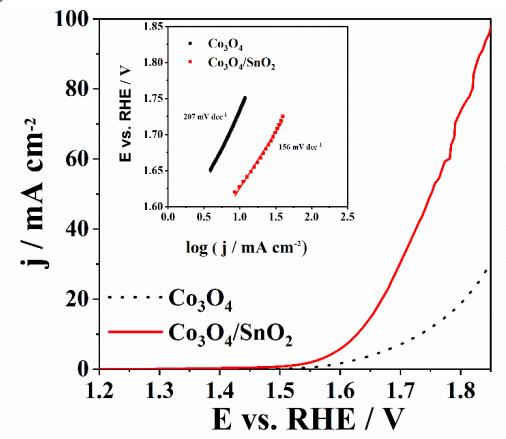
Fig. 1 shows OER polarization curves of Co3O4 and Co3O4/SnO2 electrocatalysts in alkaline media where both electrocatalysts showed high OER activity. Still, Co3O4/SnO2 gave an almost three times higher OER current density of 98 mA cm-2 than Co3O4 electrocatalyst (30 mA cm-2) at 1.85 V. Tafel slopes were found to be 207 and 156 mV dec-1 for Co3O4 and Co3O4/SnO2 electrocatalysts, respectively. A lower slope means that less overpotential is required to get a high current. In this case, Co3O4/SnO2 has a lower Tafel's slope which indicates synergetic effect of coupling two metal oxides when it comes to electro-oxidation of oxygen in alkaline media [1]. The iridium (IV) and ruthenium (IV) oxides (IrO2 and RuO2) as the best OER electrocatalysts but with low OER durability and high cost [1] could potentially be replaced with here tested Co3O4 and Co3O4/SnO2 electrocatalysts because of their low-cost synthesis, and high OER activity in alkaline media.