
Diffuse large B-cell lymphoma (DLBCL) is a genetically heterogeneous group of aggressive malignancies. It is the most common type of non-Hodgkin's lymphoma in adults. These lymphomas exhibit highly diverse clinical features and a complex molecular basis. The precursors of DLBCL cells are antigen-exposed normal B lymphocytes undergoing neoplastic transformation. There are two subtypes of DLBCL, i.e., non-OxPhos, where B-cell receptor signaling is crucial, and OxPhos, characterized by increased oxidative phosphorylation. DLBCL is a rapidly progressing cancer, so the disease must be diagnosed quickly, thus increasing the chances of a complete recovery.
Raman spectroscopy is a promising diagnostic tool that provides unique information on the biochemical composition of cells and allows the differentiation of acute lymphoblastic leukemia (ALL) subtypes in clinical samples [1] and the detection of DLBCL and chronic lymphocytic leukemia (CLL) [2]. The research aims to characterize DLBCL lymphoma cells and their subtypes by identifying biochemical, spectroscopic markers using Raman imaging.
In the study, four DLBCL lymphoma cell lines (OCI-Ly1, OCI-Ly7, Pfeiffer, and Toledo) were used as in vitro models of the disease. Normal B lymphocytes, were isolated from the peripheral blood of healthy donors. Cell Raman imaging was performed using a WITec Alpha 300 confocal Raman microscope with a 532 nm laser as an excitation source. The obtained spectra were pre-processed using Project Five 5.1 Plus software. Then, K-means cluster analysis (KMCA) was performed. In the next step, principal component analysis (PCA) was done using the Unscrambler X software. Chemometric analyses revealed subtle differences in the Raman spectra of investigated cells.
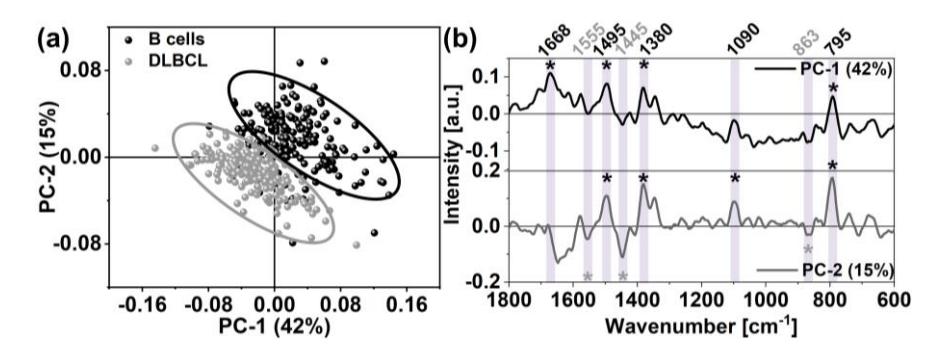
PCA analysis performed on the spectra of normal B lymphocytes and tumor cells clearly showed that both groups differ significantly (Fig. 1a). B lymphocytes were mainly characterized by the bands derived from nucleic acids, while cancer cells had a larger share of proteins and lipids (Fig. 1b). Analyzes performed within the studied cell lines also revealed biochemical differences between non-OxPhos and OxPhos DLBCL subtypes. Spectra from cells of non-OxPhos subtype (OCI-Ly1, OCI-Ly7) are separating from the OxPhos subtype (Pfeiffer, Toledo) in PCA score plots. No grouping was observed in the set consisting of OCI-Ly1 and OCI-Ly7 cell lines. In the case of the Pfeiffer cell line, each time, it was characterized by the bands derived from hemeproteins.
Raman spectroscopy has proven to be an efficient tool in order to characterize biochemical composition on lymphoma cells. Moreover, this method allowed to discover the metabolic differences of the studied DLBCL subtypes and identify their characteristic spectroscopic markers.