
Pucciniales are parasitic rust fungi with a wide range of host plants. Genus Puccinia consists of more than 4000 different species all of which are plant pathogens [1]. Puccinia is macrocyclic with five spore stages: urediniospores, teliospores, basidiospores, pycniospores, and aeciospores (Fig. 1) that vary depending on the host plant.
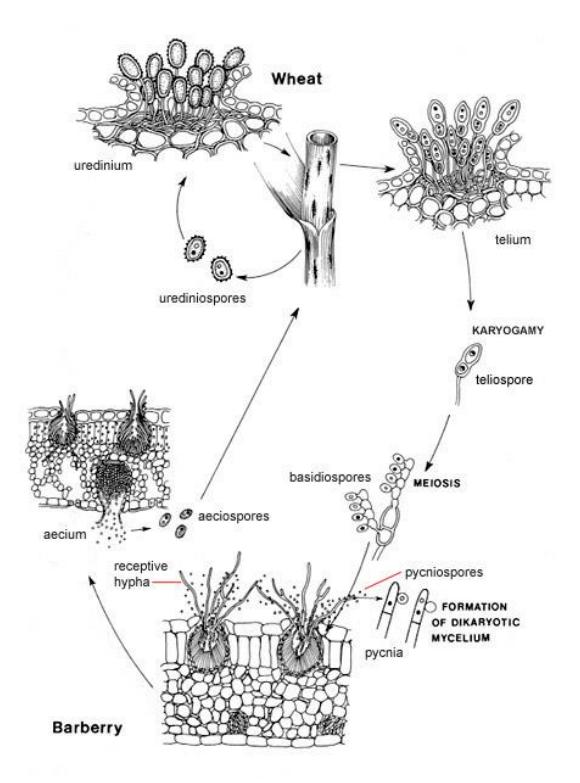
Species like P. coronata Corda, P. graminis Pers, P. recondita Roberge ex Desm, and P. striiformis Western threaten cereal crops in Lithuania and worldwide [3]. Our research aim is to compare the genetic variation of old herbarium Puccinia specimens with the corresponding ones naturally occurring nowadays. It is like looking 30–100 years back to see if, or how much Puccinia sp. changed over the last century compared with the current species.
We received herbarium specimens of Puccinia sp. from Vilnius University herbarium (WI), and the corresponding rust species were collected in a field during the 2021 season. We selected the potato dextrose agar (PDA) medium that is commonly used for growing yeast and mould for the cultivation of rust fungus species in our research. Later, we extracted fungi DNA from spores and mycelium harvested on Petri dishes to avoid cross-contamination with the host plant DNA. This step was essential, as RAPD primers are not species or taxon-specific, so they could easily anneal to plant DNA. The DNA was purified using the CTAB method or GeneJET Genomic DNA Purification Kit K0721 (ThermoFisher Scientific, Lithuania) with some modifications. After purification, the RAPD was performed to determine the polymorphism level in the DNA sequence between modern and herbarium rust specimens.
Not all the herbarium species and those collected in summer 2021 succeeded to outgrow on PDA medium. Field species that sprouted well on the medium were P. graminis, pear rust and one undefined species, while revived herbarium specimens were mostly P. graminis. The yield of extracted DNA was greater with the conventional CTAB method compared to commercial kit. However, A260/280 ratio was insignificantly variable among all samples. Eight RAPD primers (OPA-02, OPA-03, OPB-08, OPB-15, OPB-17, OPC-08, and OPG-02) were selected for further downstream genetic diversity investigation.