
Supercontinuum (SC) generation is an effect produced by filamentation of ultrashort laser pulses in transparent dielectric media and resulting in broad spectra with high spatial and temporal coherence [1]. Traditionally, SC is generated and characterized under single pulse laser exposure. Two or more laser pulses, that are equally temporally separated are called bursts of laser pulses. Material processing by bursts of laser is advantageous for various micromachining areas such as ablation, laser welding, fabrication of Bragg grating waveguides, glass scribing and cleaving [2-4]. It has been demonstrated, that SC generation can also be achieved using bursts of laser pulses in photonic crystal fiber [5]. However, to the best of our knowledge SC generation in bulk materials has not been studied.
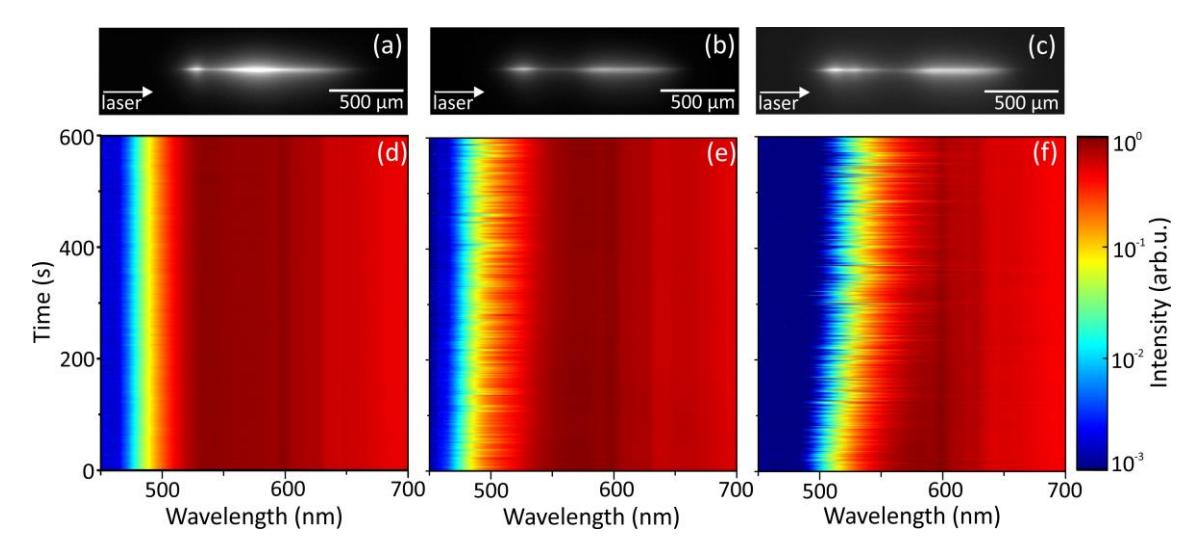
In this study, we investigate SC generation using single pulses and burst of laser pulses temporally separated by 400 ps and 16 ns provided by amplified Yb:KGW laser (Carbide Light Conversion Ltd.) laser having a pulse duration of 210 fs and a central wavelength of 1030 nm.
We examined SC generation in 5 mm sapphire and YAG crystals using single and 2 pulses burst with 400 ps and 16 ns time separation between the pulses with the 500 kHz repetition rate. Sapphire crystal degrades rapidly using even a single pulse and no stable SC generation was observed with both types of bursts. In contrast, stable SC generation in YAG crystal was observed with single pulse and standard deviation of spectral intensity fluctuations (≈ 0.6%) were measured for 550 nm wavelength (Fig. 1). Fairly stable SC generation was achieved with 16 ns bursts (for 550 nm spectral intensity fluctuations ≈ 1%) although with slight shrinking of SC spectrum, while rapid narrowing of SC spectrum and highest spectral intensity fluctuations ≈ 9 % for 550 nm wavelength were measured using 400 ps bursts indicating rapid optical degradation of the crystal.