
Crystalline δ–Bi2O3 is the best known O2- ion conductor, but it is stable in a relatively narrow temperature range 729-825 °C only. Its very high ionic conductivity (1 S/cm at 750 °C) has motivated many researchers to look for a method to stabilize this fluorite-type structure to lower temperature. So far the successful strategies to achieve the stabilization of the delta phase have included doping (e.g. by rare-earth elements [1]) or synthesis in form of thin layers [2].
Our approach to reach the same goal is significantly different from those two strategies. It consists of two steps: preparation of the Bi2O3 glass (pure or doped) and its nanocrystallization. Our experience with nanocrystallization has shown that by the appropriate heat-treatment one can achieve a gigantic (even by a factor of 109) and irreversible electrical conductivity enhancement in glassy analogs of some cathode materials for Li-ion batteries [3,4]. This effect is closely related to changes in the microstructure – namely to formation of nanoscale crystalline olivine grains, with dimensions going down even to a few nanometers, confined in the glassy matrix.
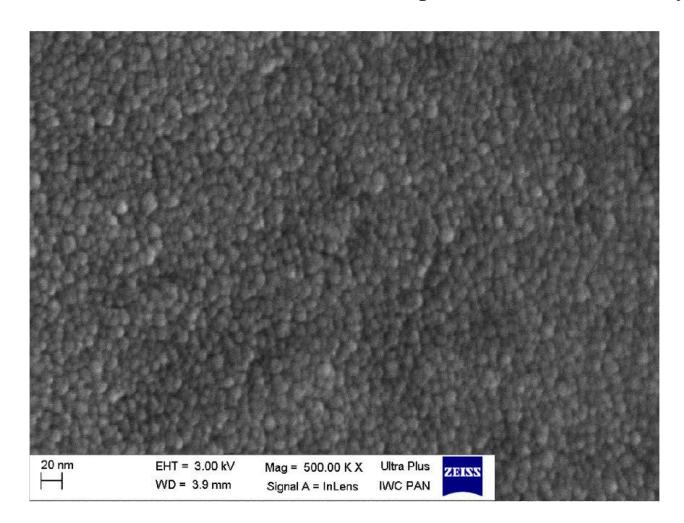
In this research, we first obtained Bi2O3 glasses at various synthesis conditions. Al and Si additives, originating from the crucibles, facilitated the glass formation upon quenching. Then we subjected them to an appropriate thermal treatment [5]. As a result, materials with various crystalline Bi2O3 phases were obtained: delta, beta and gamma – depending on the synthesis conditions. The phases (including delta) were found to be stable down to room temperature. The microstructure of samples was investigated by electron microscopy techniques (both SEM and HRTEM). The grains of δ–Bi2O3 phase were observed always as 10–40 nm nanocrystallites, confined in a residual glassy matrix (Fig. 1). On the contrary, the grains of beta and gamma phases were of micrometer sizes. The total electrical conductivity of nanocrystallized samples as a function of temperature has been determined in preliminary measurements by impedance spectroscopy.
MAS NMR was applied to determine the neighborhood of Al and Si, and to investigate their role in the stabilization of the Bi2O3 phases. From this experiment, one can conclude that Al and Si additives are rather unlikely to stabilize directly the delta-like phase, because they remain in amorphous matrix. On the contrary, they are believed to participate in formation of glass and induce the confinement effect of pure delta-Bi2O3 nanocrystallites.