Using the Large Hadron Collider (LHC) at CERN, scientists perform high-energy proton-proton collisions, which allow them to test predictions of different particle physics theories. Colliders like LHC reach a much higher center-of-mass energy than fixed target setups. Energy of proton-proton collisions at LHC reaches 13 TeV, which is the highest man-made collision energy ever achieved. A lot of new particles are produced during such collisions. Some of them are very heavy and decay almost instantly.
The Compact Muon Solenoid (CMS) is one of the four large particle detectors at the LHC. It is a general-purpose detector, used to study the Standard Model, search for extra dimensions and particles that possibly could make up dark matter. CMS has systems designed to measure the energy of electrons, photons, and other collision products. It uses a triggering system that allows it to register the rarest events that are later stored to be analyzed by physicists.
The Drell-Yan process occurs in high energy hadron-hadron collisions when a quark and an antiquark annihilate and create a lepton-antilepton pair. This process is interesting to scientists because its measurement results help them to test theoretical calculations of perturbative Quantum Chromodynamics (QCD), provides constraints on the evaluation of parton distribution functions (PDFs), which describe the inner structure of the proton. Drell-Yan also allows physicists to refine hadronization models, descriptions of the proton collision process and so on. However, it is very important to have the highest possible measurement accuracy to be able to refine the theory as much as possible.
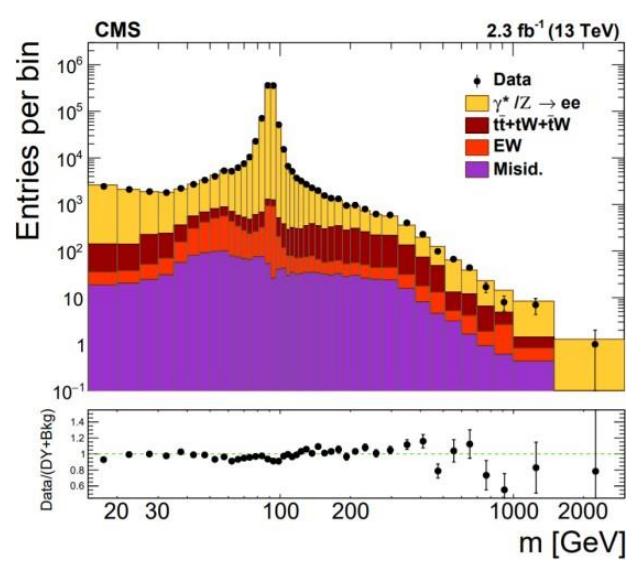
Drell-Yan process cross section depends on several different parameters, and those different dependencies are measured by different scientific groups. The measured distributions always contain some percentage of background that needs to be estimated in order to measure the correct cross section. The easiest way to estimate background is to use Monte Carlo (MC) simulation, but it has its own uncertainties, such as imperfect modeling of detector response. To get rid of those uncertainties, scientists choose to estimate the background events using data-driven methods. Background processes that may produce two leptons of the same or different flavors are predicted using the $e\mu$ method, which will be presented in more detail during the conference.