SYNTHESIS AND INVESTIGATION OF PHENANTHROIMIDAZOLE DERIVATIVES FOR ORGANIC LIGHT EMITTING DIODES
Lukas Graibus1, Rita Butkutė1, Juozas Vidas Gražulevičius1
1 Department of Polymer Chemistry and Technology, Kaunas University of Technology, Kaunas, Lithuania
Technology of organic light emitting diodes (OLED) is currently considered to be the most promising technology for the transformation of electricity into light. OLEDs are used in the fabrication of displays of various electronic devices and in lighting appliances [1]. Compounds exhibiting thermally activated delayed fluorescence (TADF) are currently considered to be the most promising emitters of OLEDs. TADF emitters can be synthesized from low-cost organic reagents without the use of rare metals or toxic elements [2, 3]. They usually consist of donor and acceptor moieties. Due to low-cost synthesis, blue emission, bipolar charge transporting properties, and excellent thermal stability, donor-acceptor phenanthroimidazole derivatives are promising as emitters and hosts for emissive layers of OLEDs [4].
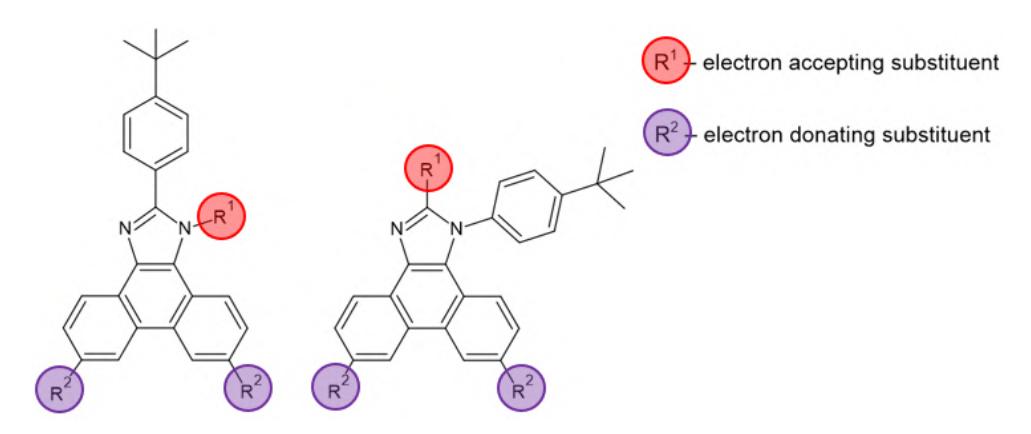
In this presentation we report on the synthesis and investigation of new donor-acceptor type bipolar, blue-emitting phenanthroimidazole derivatives.
Fig. 1. Structures of phenanthroimidazole-based compounds containing both electron donating and accepting moieties.
The synthesized derivatives were characterized by 1H and 13C NMR, IR spectroscopy, mass spectrometry. The thermal, optical, photophysical, electrochemical and photoelectrical properties of the materials will be presented.
Acknowledgments: This project has received funding from the Research Council of Lithuania (LMT), project Nr. 09.3.3.-LMT-K-712-25-0025.
[1] H. Chen, J. Lee, B. Lin, S. Chen, S. Wu, Liquid crystal display and organic light-emitting diode display: present status and future perspective, Light: Science & Applications, Vol. 7, 17168, 2047-7538/18 (2018), doi: 10.1038/lsa.2017.168.
[2] M. J. A. Talite, H. T. Lin, Z. C. Jiang, T. N. Lin, H. Y. Huang, E. Heredia, A. Flores, Y. C. Chao, J. L. Shen, C. A. J. Lin, Solid-state, ambient-operation thermally activated delayed fluorescence from flexible, non-toxic gold-nanocluster thin films: towards the development of biocompatible light-emitting devices, Nanotechnology, 27, 345701 (2016), doi: 0.1088/0957-4484/27/34/345701.
[3] K. Yamaguchi, T. Matsushima, A. S. D. Sandanayaka, Y. Homma, N. Uchida, C. Adachi, Enhanced Operational Durability of Thermally Activated Delayed Fluorescence-Based Organic Light-Emitting Diodes with a Triazine Electron Transporter, Chemistry Europe, 26, 5598–5602 (2020), doi: 10.1002/chem.201905345.
[4] S. Ye, S. Zhuang, B. Pan, R. Guo, L. Wang, Imidazole derivatives for efficient organic light-emitting diodes, Journal of Information Display, Vol. 21, No. 3, 173–196 (2020), doi: 10.1080/15980316.2020.1802357.