
The aim of the thesis is to present the results of a semi-empirical calculations of the Landé $g_J$ factors, along with energy levels, fine (fs) and hyperfine structure (hfs) for the odd parity-level system of the holmium ion (Ho II). For this purpose we used our package of programs for semi-empirical analysis of energy levels structure of complex atoms. To obtain the results, all available experimental data were used.
Knowledge of holmium neutral and ionized spectra helps scientists to interpret the results of various experiments, observations in astrophysics or solve problems of quantum engineering. It's also essential in cosmology. The distribution of elements in Galaxy provides critical information about the process of nucleosynthesis in stars. It allows to get better understanding of the history of the Universe, which would be impossible without very detailed spectral data. Values of Landé $g_J$ factors are essential in planning trapping and cooling atoms or ions experiments.
The considered configuration system consisted of 5 odd configurations: $4f^{11}6s+4f^{11}7s+4f^{11}5d+4f^{10}6s6p+4f^{10}5d6p$. The procedure of calculating the energy structure of a complex atom using semi-empirical methods begins with the determination of the fine structure. For this purpose our own fine structure parameterization method were used, taking into account all electromagnetic interactions in an atom up to the second-order perturbation theory. The eigenvector amplitudes determined by means of the fine-structure analysis were used next in the process of the hyperfine structure parameterization.
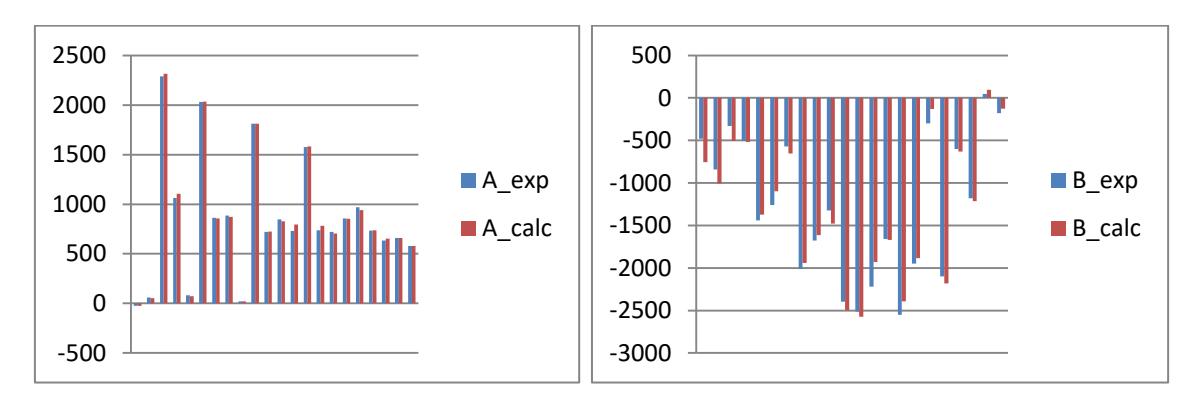
Basing upon precise experimental magnetic dipole and electric quadrupole hyperfine structure constants A and B presented by Gurell et all. [3], we have made an attempt to extract some attributes for the odd-parity configuration system of Ho II, such as predicted values of energy levels with their Landé $g_J$ factor as well as and hfs constants. The correctness of the fine structure wave functions was verified by the simultaneous analysis of the hyperfine structure. Using 22 experimental hyperfine structure constants very good results of hfs parameterization were obtained. In the final fine structure least-square fit we achieved a mean error for the energy levels values of $\sigma(E) = 15$ cm-1 and the mean relative discrepancy amounting to 0.1%. The differences between experimental and calculated values of hfs constants are presented in Fig. 1. Therefore, we conclude that the obtained wave functions describe the real electronic states, and the predicted Landé $g_J$ factors are properly determined for both the experimental energy values and the calculated energy values in the range up to 30000 cm-1.
We are hoping that the results of our calculations will be confirmed in near future by experimental studies.