Subnanosecond (from 100 ps to 1 ns) optical parametric generators (OPGs) are continuously tunable in a wide spectral region and can be applied in spectroscopy, gas detection, biochemical research where high temporal resolution is not necessary but nanosecond time resolution is not sufficient enough. Such tunable coherent light sources are commercially attractive because of their quite simple configuration, compactness and relatively low-cost. Although there is demand, but only a few subnanosecond OPGs have been obtained because of damage threshold of nonlinear media for subnanosecond pulses being very near the threshold of optical parametric generation [1-3].
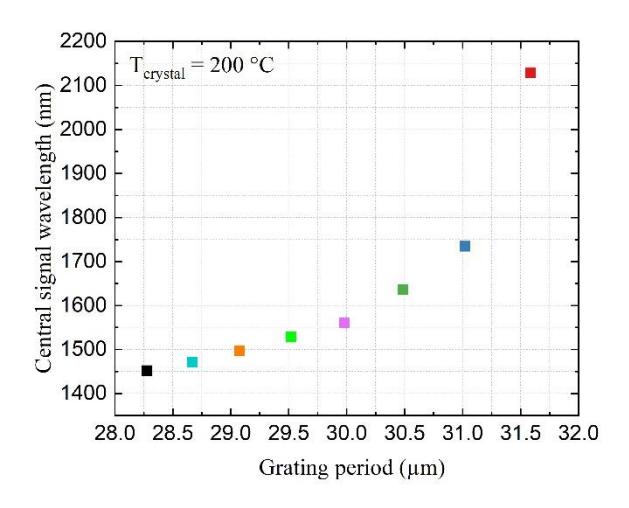
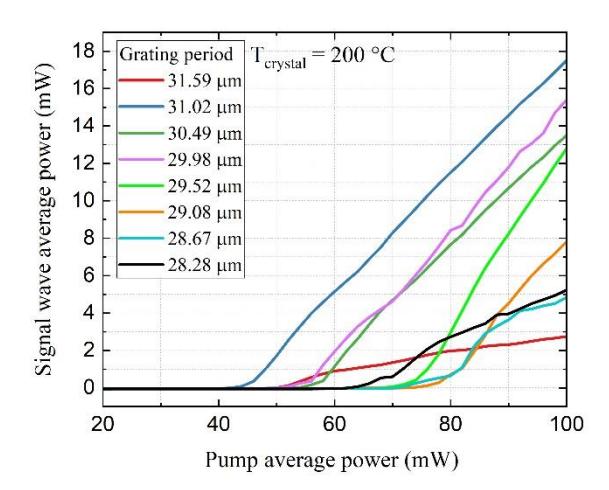
In this research we investigated an OPG based on a 1 cm in length periodically poled 5 % magnesium-oxide-doped lithium niobate (MgO:PPLN) crystal pumped by Nd:YAG MOPA microlaser that produces up to 1 W power of 473 ps 1064nm wavelenght pulses with 1 kHz repetition rate. The use of a short crystal can further reduce the cost of such a tunable broadband coherent light source. The crystal has 8 gratings varying from 28.28 μm to 31.59 μm in period. When using grating tuning (Fig.1) and temperature tuning from 60°C up to 200°C we obtained signal wave tuning from 1439 nm to 2120 nm and respectively calculated idler wave tuning from 2769 nm to 4166 nm. Energy characteristics were measured as well. Dependency of optical parametric generation output power on pump power at different crystal temperatures is shown in Fig.2. Calculated signal wave frequency conversion efficiencies for different gratings vary from 2.8 % up to 17.5 % when crystal was heated to 200°C temperature. For the development of a more effective OPG longer crystals will be investigated.