Among all the semiconductors, zinc oxide (ZnO) is broadly and tremendously attracted material due to its multifunctional characteristics including a huge band gap of ~ 3.37 eV and an excessive exciton binding energy ~60 meV at room temperature, moreover it is an environmentally friendly, low visible absorption and low-cost material. Therefore, ZnO is a promising material for ultraviolet (UV) photodetector and sensor applications [1]. The potential of ZnO to absorb ultraviolet light (10-400 nm) is implemented in the manufacturing of solar cells coatings and ultraviolet sensors [2]. ZnO is an inorganic compound observed in the form of a white powder, nearly insoluble in water. ZnO is an incredibly soft material with a Mohs hardness of ~ 4.5 [3]. Single nanowire (NW) UV sensors exhibit very high ON/OFF ratios between photoresponse currents and dark currents due to their large surface area to volume ratio and high-quality crystal structure. Practical applications require large-scale, low-cost integration, compatibility with flexible electronics, and sufficiently high photoresponse currents to be detected without high-precision measurement systems [4]. By illuminating the surface of the ZnO coating with ultraviolet light, it is able to create free vacancies of the oxygen atom, which adjusts the internal properties of the material, along with growing the n-type conductivity and wetting the material. Such properties have also great potential in room temperature UV and humidity sensing.
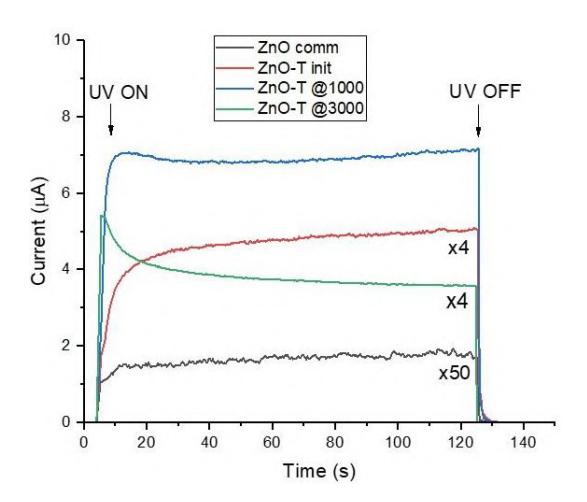
In this work we investigated our ZnO nanotetrapod (ZnO-T) sensors and compared with commercially available kadox. Tetrapods were obtained by continuous combustion synthesis [5], and further separated into lower dimension fractions using centrifugation (1000 and 3000 rpm) of initial ZnO-T powders. UV photodetection ($\lambda$ =365 nm) were measured with an electrometer in ambient air with a controlled relative humidity of 40%. The UV response was described as the ratio of current in the dark (Idark) to current under UV illumination (IUV). It was found that even at low UV power density (0.31 mW/cm2) ZnO-T sensors show much better results compared to their commercial nanoparticle sensor counterparts. Commercial ZnO nanoparticles have the lowest IUV/Idark ratio (1020 %) compared to the highest of ZnO-T @1000 (307350 %). Other ZnO-T ratio was 105200 % (ZnO-T before centrifugation) and ZnO-T @3000 7470 %.