Visual Light Communication (VLC) is a promising and emerging technology employing visible light modulation for high-speed data transfer. Although visual light communications dates back to the end of 19th century, this technology received more attention in last 20 years in particular after invention of high-power Light-Emitting Diodes (LEDs). This communication is immune to electromagnetic interference, safe to use and environment-friendly. Considering the fact that VLC technology has no electromagnetic pollution, it can be applied to medical appliances, aircrafts, industrial control and other radio frequency sensitive areas. While lasers are used for a long-distance communication, the data transfer rates up to several Gbit/s at short distances could be achieved by LEDs.
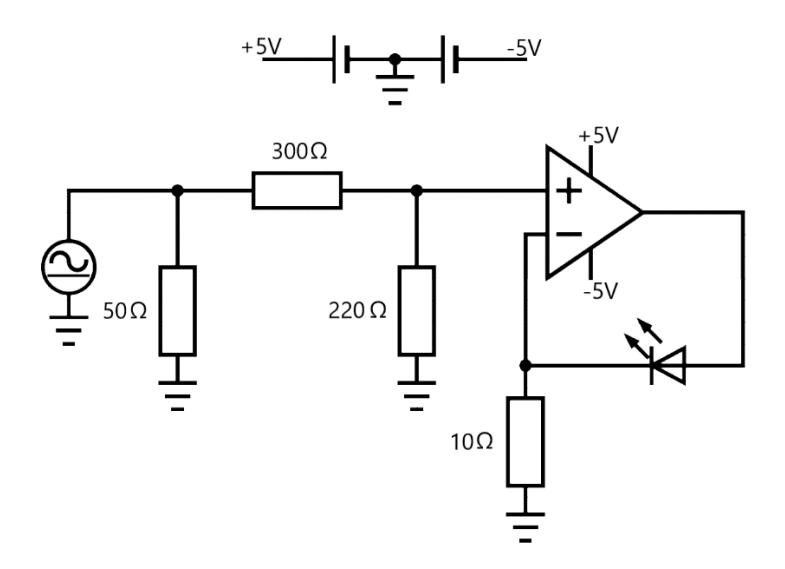
Here we present a short study of simple LED modulation circuit based on high-speed and high-power operational amplifier (LM7171). Modulation frequency throughput of the circuitry and sample LEDs was measured as the most important parameter for high-speed data transfer. In addition, electrical and optical properties of the LEDs were investigated separately.
We conclude that high brightness LEDs can be modulated at tenths of MHz with such a simple circuitry and could be applied for the data transfer at tenths of Mbit/s rate. On the other hand, high-power LEDs exhibited much lower modulation cut-off frequencies.