
The advantages that organic light emitting diode (OLED) based technologies offer in terms of brightness, viewing angle, contrast ratio, production cost, opportunity for flexible displays, etc. are not rivaled by liquid crystal-based displays [1]. It is well established that multilayer devices comprising hole transport layer (HTL), electron transport layer and emissive layer are necessary for efficient light emission [2-4].
Solution processed derivatives containing substituted carbazole fragments are among the most studied materials for organic electronics due to their good chemical and environmental stability as well as high positive charge mobility in their layers. In addition, derivatives containing electronically isolated carbazole chromophores have high triplet energies and are widely used as host materials for electro-phosphorescent devices [5].
New electro-active polymers having 4,7-diarylfluorene chromophores were prepared by cationic polymerization of the corresponding oxetane-based monomers. The structures of polymers 7-9 containing the electroactive 2,7-diarylfluorenyl chromophores are shown in Figure 1.
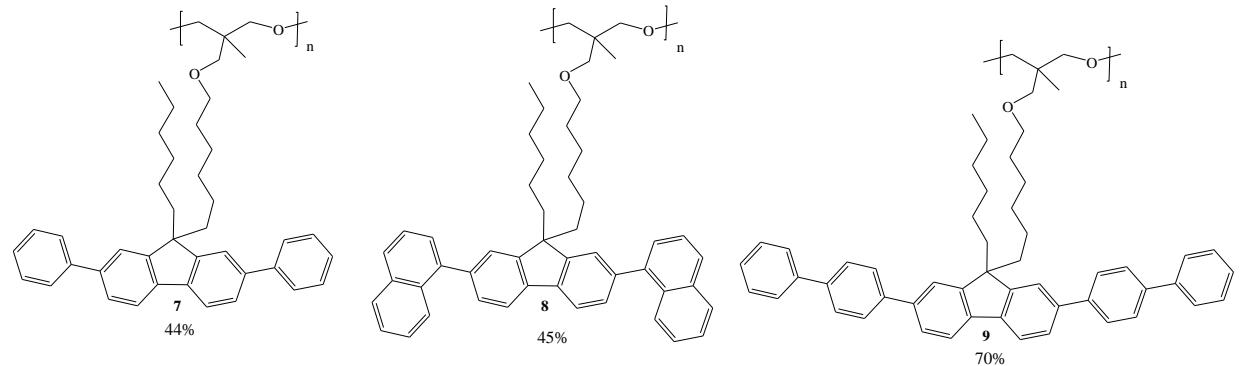
The newly synthesized derivatives were identified by mass spectrometry (for low-molar-mass compounds), IR and 1H NMR spectroscopy as well as by elemental analysis. The data were found to be in good agreement with the proposed structures. The polymers 7 - 9 were soluble in common organic solvents at room temperature. Amorphous thin films of these materials could be prepared by using cheap spin coating technique.
The amorphous materials demonstrated very high thermal stability (392-397 °C) and glass transition temperatures in a range of 28-63 °C. Electron photoemission spectra of thin films of the polymers confirmed that ionization potentials of the materials are depending on their chromophores and are in a range from 5.8 eV to 6.0 eV. The polymers have been tested as positive charges transporting layers in bilayer organic light emitting diodes with tris(quinolin-8-olato)aluminium as an emitter as well as electron transporting layer. An OLED device with polymer having electro-active 2,7-di(4-biphenyl)fluorine chromophores exhibited the best overall performance with low turn on voltage of 3 V, maximum brightness exceeding 200 cd/m2 and current efficiency of 1.7 cd/A.