
COVID-19 is a highly contagious respiratory infection. An attractive therapeutic target for SARS-CoV-2 (severe acute respiratory syndrome 2, etiologic agent of COVID-19) is the main protease (Mpro), as this enzyme plays a major role in the processing of viral polyproteins. SARS-CoV-2 Mpro is a dimer formed by two monomers, each consisting of three domains. Since Mpro SARS-CoV-2 is active in dimeric form only, effective drug development strategies can include the search for inhibitors aimed at dimerization [1].
The aim of this study was to identify a number of ligands that are capable of inhibiting Mpro activity by interacting with the enzyme dimerization site. Drugs targeting Mpro SARS-CoV-2 can inhibit viral replication and, due to the highly conserved primary enzyme structure in different members of the coronavirus family, reduce the risk of mutation-mediated drug resistance while exhibiting broad-spectrum antiviral activity.
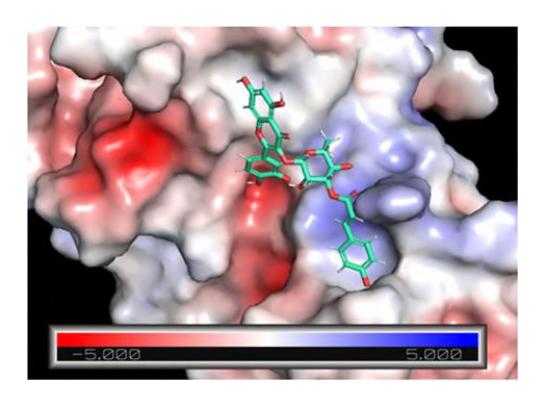
During the search for compounds capable of binding to the dimerization site of Mpro protease with the most favorable indicators of free binding energy 8,793 ligands approved for medical use by the FDA and other major jurisdictions, 111178 substances frequently detected in food products, and 8 million compounds that do not contain PAINS (pan assay interference compounds), were analyzed via Schrodinger Glide [2], a ligand docking program that uses an empirical scoring function (XP GScore) as a measure of the ligand free binding energy, which led to the identification of 8242 compounds with XP GScore values below - 5 kcal / mol.
Screening of substances approved for use as medication in the United States, the EU, Japan and China was carried out first and foremost. As a result, thirteen compounds with binding scores ranging from -5 to -9 kcal / mol were identified. From the "in man" subgroup of the ZINC15 database used as a source for structures of compounds frequently detected in food products, 41 compounds with XP GScore ranging from -10.9 to -8 kcal / mol were identified. In the ZINC subgroup anodyne, from which substances that do not contain interfering structures (PAINS) were obtained, we found 8188 compounds with XP G Score values less than -5.8 kcal / mol.
Ligands with best XP GScores were used for MD simulation studies with GROMACS [3]. To ensure the stability of ligand-protein complexes standard deviations, calculated by performing least squares approximations for the protein-ligand complexes were compared to the values obtained for the Mpro protease not bound to the ligand. Calculations showed sufficient stability of most Mpro-ligand complexes.
Our study introduces a number of ligands capable of forming complexes with the dimerization site of Mpro SARS CoV 2. These compounds work primarily via forming hydrogen bonds, salt bridges, and pi-cation interactions with amino acids vital for dimerization, for example LYS4; ARG5; TYR126; VAL125, GLU290, LYS137, PHE140; GLU166 and others. Several compounds that successfully underwent clinical trials and were approved by FDA for medical use were found to possess high binding affinity to dimerization site of Mpro SARS CoV 2, which opens the possibility for drug repurposing.