
Tagetes patula natural extracts are widely used in pharmaceutical industry because of their antioxidant and antibacterial activities. In traditional and homeopathic medicine it has been used for wounds and burns, skin complaints, conjunctivitis and poor eyesight, varicose veins, menstrual irregularities, hemorrhoids, etc. Tagetes patula grows as common garden plant throughout North America and Europe. The flowers of these plants are bright-yellow or brownish-yellow or golden-orange and are used as spice, tea and medicine. They may be used as fresh or dried, and can be made into tea, tinctures, ointments and creams. Tagetes patula is a popular plant found in the Asteraceae family and it is widely cultivated for the extraction of carotenoids, as well as for its decorative properties. It has been used to treat a wide variety of diseases and conditions in traditional medicine since ancient times. The pharmacological activity of Tagetes patula is related to the content of several classes of secondary metabolites such as flavonoids, essential oils, sterols, tannins, carotenoids, saponins, polysaccharides, triterpene alcohols, a bitter principle, mucilage, and resin. Tagetes patula flowers contain rutin, isoquercitrin, isorhamnetin-3-O-rutinosylrhamnoside, quercetin-3-O-rutinosylrhamnoside, isorhamnetin-3-O-glucoside and isorhamnetin-3-O-glucosylglucoside.
According to the fact that Tagetes patula contains polyphenols, the assessment of its antioxidant properties is of great interest in the understanding of positive effect of these compounds.
Plant cell and tissue culture was developed in order to study the biochemistry of plants without the complication of the whole plant. Plant callus cultures in vitro were found to accumulate of the compounds characteristic of the original plant.
The current research has been designed to access antioxidant properties of Tagetes patula plant in vivo and Tagetes patula plant callus cultures in vitro using 2,2-diphenyl-1-picrylhydrazyl radical scavenging assay (DPPH) and reducing antioxidant power assay methods [1, 2].
Extracts of the leaves, flowers and stems in vivo of Tagetes patula and callus cultures in vitro were used for the study.
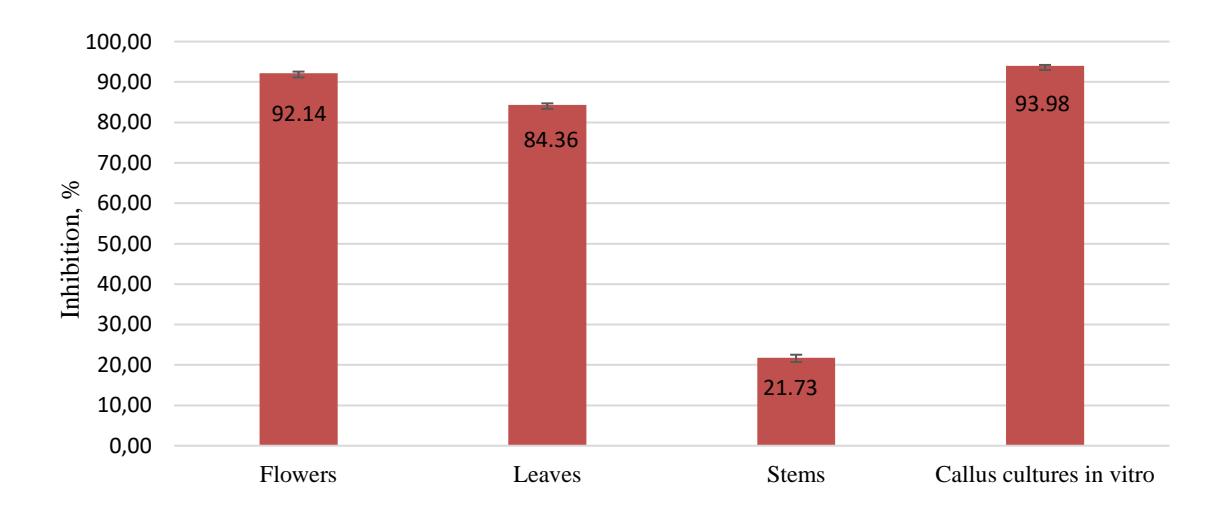
Study analysis showed (Figure 1), that highest antioxidant activities (93.98 % and 92.14 %) according to DPPH method of Tagetes patula plant extracts was in analysed plant callus cultures, which were formed in Murashige and Skoog medium with TDZ (0.5 mg/l) and IAA (0.1 mg/l), and in Tagetes patula flowers. The lowest antioxidant activity of the extracts was in stems of Tagetes patula in vivo.
The present study could be helpful to reveal new sources of antioxidant and antibacterial phytochemicals for potential biotechnological studies of Tagetes patula callus cultures in vitro.