Recent technological miniaturization trends show a growing need for an improvement in the quality of microprocessing technologies. Currently available solid state laser systems deliver ultrashort, high-intensity pulses and are a common choice when there is a need for high precision in microfabrication. However, the beam of these systems has a gaussian intensity distribution, and material ablation corresponding to one pulse is also gaussian – the oval pit is left on the surface. Unfortunately, gaussian intensity distribution is no longer sufficient for maintaining extremely low roughness in polishing applications. That is where diffractive optical elements (DOE) play an important role in the improvement of accuracy and processing speed in various micromachining methods. By manipulating the incident beam's phase, these microstructured elements are able to obtain a desired beam intensity distribution. One of the commonly used elements is a flat-top beam shaper, which forms a square shaped beam with a homogeneous intensity distribution [1]. After interacting with the material, a laser pulse shaped like this would leave a squared pit with a smooth bottom. Since the micro-structuring resolution of these elements is a key point in achieving a great beam conversion efficiency, they are mostly manufactured by using lithographic methods, as these techniques are associated with an ability to achieve small feature sizes in the order of tens of nanometers [2, 3]. However, these methods are quite expensive and robust if compared to the direct laser ablation technique.
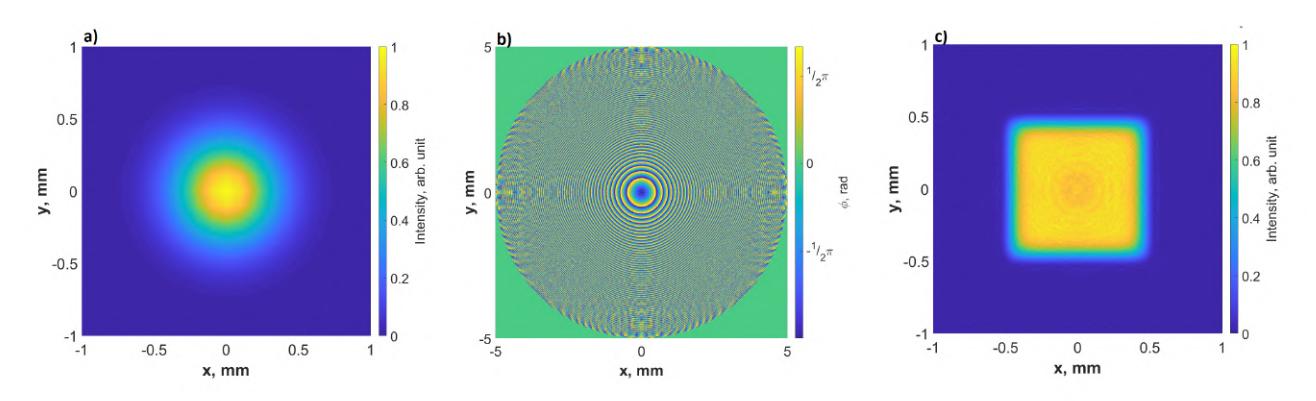
In this study, we present modelling results of a phase mask, adapted for manufacturing with our experimental setup, which consists of Yb:KGW laser system (PHAROS, Light Conversion) with 5th harmonic generator, Aerotech ANT180 micro-positioning system, and calcium fluoride lenses for beam focusing. The phase mask, producing a flat top intensity distribution at the far field, was generated by the LightTrans company's software package "VirtualLab" which uses the iterative Fourier transformation algorithm [4]. Geometrical microstructuring parameter optimization was conducted and an optimal parameter set was found (10 μm x 10 μm pixel size and 5 phase levels), resulting in the highest experimentally obtainable conversion efficiency of 85 percent. It was also noticed that by increasing the number of phase levels up to 7, conversion efficiency increases and saturates above that value.