Development of InGaN-based photonic devices enabled the commercialization of efficient blue light-emitting diodes (LEDs) and laser diodes (LDs), white light sources. The main challenge in development of long-wavelength InGaN LEDs is the decrease of radiative efficiency, which is usually attributed to higher strain and increased defect density. One of the approaches to solve this problem is based on a low-indium-content InGaN underlayer or superlattice (SPSL) below the active region multiple quantum wells (MQWs), which leads to higher efficiency values. However, the origin of such efficiency increase is still not clear: several groups have contributed this effect to the strain relaxation between GaN and InGaN/GaN MQW layers [1], while recent studies link the inclusion of SPSL to lower defect density in the active region [2,3].
In this study, eight InGaN/GaN MQWs samples were studied. Samples were grown on sapphire substrate by metalorganic chemical vapor deposition (MOCVD), and were composed of n-GaN buffer layer on top of which SPSL or InGaN/GaN MQWs or both of these structures were grown. The samples differed in the number of SPSL periods and SPSL growth temperature. Optical properties of the samples were studied by using photoluminescence (PL) spectroscopy. PL measurements were performed in a wide range of temperatures from 8 to 300 K. The CW semiconductor laser (405 nm) was used to excite the samples.
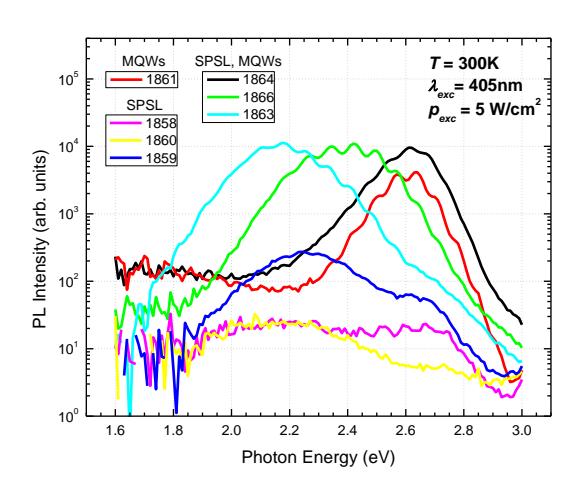
The room-temperature PL spectra of the studied samples showed that MQWs-related PL band is stronger by almost two orders of magnitude compared to the SPSL-related PL band (see Fig. 1.). The inclusion of SPSL structure below the active region resulted in the redshift of PL band and its broadening. Strong carrier localization was evidenced by the large PL band widths as well as the characteristic S-shaped peak position temperature dependence. Obtained PL efficiency values revealed that introduction of SPSL below the MQWs led to an efficiency improvement from 3% (for the sample containing only MQWs) to 6% and 11% (for the samples containing both SPSL and MQWs). However, it was accompanied by the slight reduction of In content in the active region MQWs.