
Due to the development of a deeper understanding of the relationship between photosynthesis and fluorescence parameters, chlorophyll fluorescence measurements are frequently used to monitor photosynthetic performance. The processes of photochemistry and emission are in direct competition for excitation energy. Therefore, if the rate of one process increases, the rate of the other one decreases [1]. Characean algae represent a unique model to study photosynthesis. Upon irradiation with actinic light characean internodes develop alternating pH bands along their surface [2]. This phenomenon is known to be beneficial for photosynthesis, as increased photosynthetic efficiency is observed at the acid zones [3]. However, whilst emission parameters can be easily acquired, many different factors can affect fluorescence in a similar way. Thus, further evaluation of changes in fluorescence parameters is needed to understand complex physiological patterns.
An optical fiber system paired with controlled stepper motor enabled registration of chlorophyll fluorescence signals along Nitellopsis obtusa internodes in 1 mm intervals. A low intensity ($<$ 1 mW) LED light source emitting at 405 nm was used for excitation. Two types of experiments were carried out to determine fluorescence parameters best suited to monitor photosynthetic activity - signals were registered in dark-adapted internodes and in cells that underwent no dark adaptation.
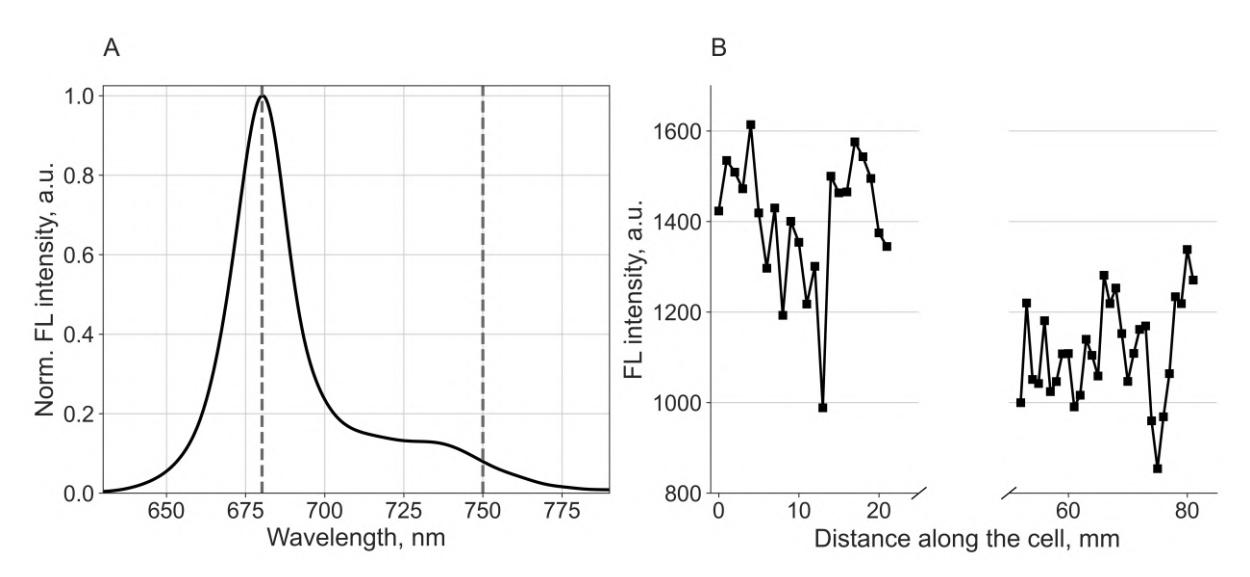
Algae exhibited a chlorophyll fluorescence spectrum with two peaks around 680 nm and 739 nm (Fig. 1A). Fluorescence intensity values registered at the first peak displayed variations along the cell (Fig. 1B) in accordance with changes of fluorescence intensity ratio between 680 nm and 750 nm (F680/F750). Patterns of alterations of maximum fluorescence intensity remained similar regardless of illumination, however, variation of the F680/F750 ratio was significantly lower in dark-adapted cells compared to internodes that underwent no dark adaptation. This result could be related to the disappearance of pH banding in the dark as this phenomenon causes changes of photosynthetic performance, yet is only observed after constant illumination.
Hence, the F680/F750 fluorescence ratio is a more suitable parameter to draw conclusions about physiological changes in algae cells than the peak fluorescence intensity value as it is less affected by non-physiological factors.