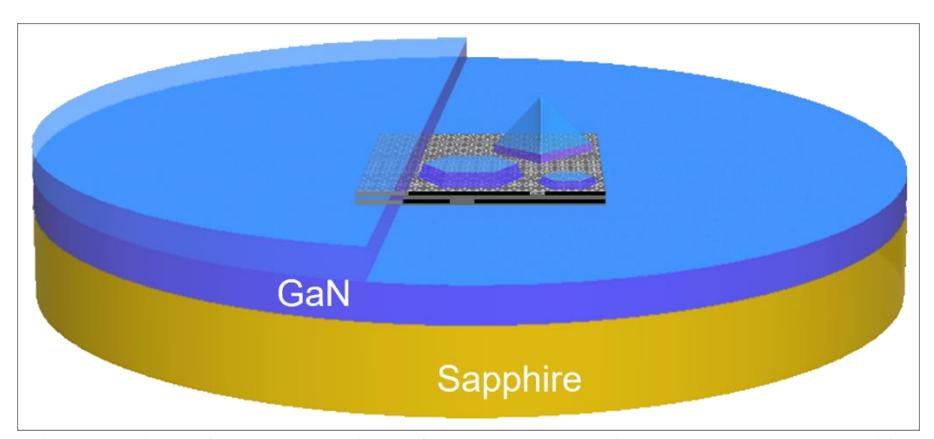
Graphene turns epitaxial GaN substrate into a copy machine enabling the process known as remote epitaxy [1]. During metalorganic vapor phase deposition, growing crystalline layer bonds to van der Walls surface of graphene relatively weakly. Non-covalent interaction results in a facile membrane release. A seeding effect from the substrate beneath manifests in the formation of a high-quality membrane. Practical benefits of remote epitaxy include: cost savings due to the reusable substrate, novel designs of flexible devices due to exfoliated thin films; and dissimilar material integration by stacking freestanding membranes. However, the process of remote epitaxy is relatively unexplored and needs further refinement.
In this work, we investigated the main steps of remote epitaxy, including the transfer of multiple graphene layers, as it was previously shown for bilayer graphene to permit interaction between the seeding GaN layer beneath and the growing layer on top [2]. Both dry and wet transfers were implemented. Lower cost and better initial quality led to the adoption of the wet transfer process. The properties of transferred layers were investigated by Raman spectroscopy.
High temperature combined with reactive species in the MOVPE process atmosphere could be detrimental to graphene. Initial growth temperature effects on the quality of graphene were investigated. A two-step growth protocol, including nucleation at optimal 700 °C temperature, was developed to grow high-quality GaN membranes [3]. Fully coalesced crystalline films were investigated by atomic force microscopy, transmission electron microscopy, X-ray diffraction, and photoluminescence techniques. Successful exfoliation of GaN thin film was demonstrated.