
Triplet-triplet annihilation (TTA) mediated NIR-to-visible photon upconversion (UC) attained under incoherent and low power excitation is a rapidly advancing field of photonics with promising applications in photocatalysis, bio-imaging, photovoltaics, targeted drug delivery and night vision devices. [1-3] Generally, TTA-UC systems are comprised of a sensitizer and an emitter. The sensitizer is responsible for absorption of low energy photons and generation of triplet states via intersystem crossing, whereas the emitter accumulates those triplets and performs TTA resulting in upconverted emission of higher energy. Currently, there is a lack of efficient, stable, and tunable TTA emitters in the visible range preventing numerous possible applications. In this work, the modified diketopyrrolopyrrole (DPP) compounds are proposed as the tunable and stable alternatives [4] to widely used rubrene and perylene diimide emitters.
Five DPP compounds (DPP-eh, DPP-c, DPP-s, DPP-Ph, DPP-2Ph) functionalized with different moieties were investigated as the emitters for NIR-to-visible UC. Palladium-phthalocyanine (PdPc) served as a sensitizer in this study. Essentially, the DPP compounds exhibited high $\Phi_{\text{FL}}$ (64% - 74%) in the isolated form and a red shift of FL spectra with increasing the complexity of the moieties allowing to implement the tunable UC. DFT modelling was found to be in agreement with experiment and showed the same trend of singlet energy reduction. All DPP derivatives demonstrated the feasibility for TTA in a solution with moderate $\Phi_{\text{UC}}$ (0.4% - 2.3%) as compared to the widely used rubrene ($\Phi_{\text{UC}}$ = 5.6%). (Fig. 1) While most of the derivatives exhibited UC threshold in the range of 6 – 22 W/cm2, the compound with large side moieties (DPP-2Ph) expressed a way higher threshold (>100 W/cm2) making $\Phi_{\text{UC}}$ determination impossible. Furthermore, DPP compounds displayed significant aggregation in the solid state facilitating strong non-radiative decay, and thus, complete inhibition of UC emission.
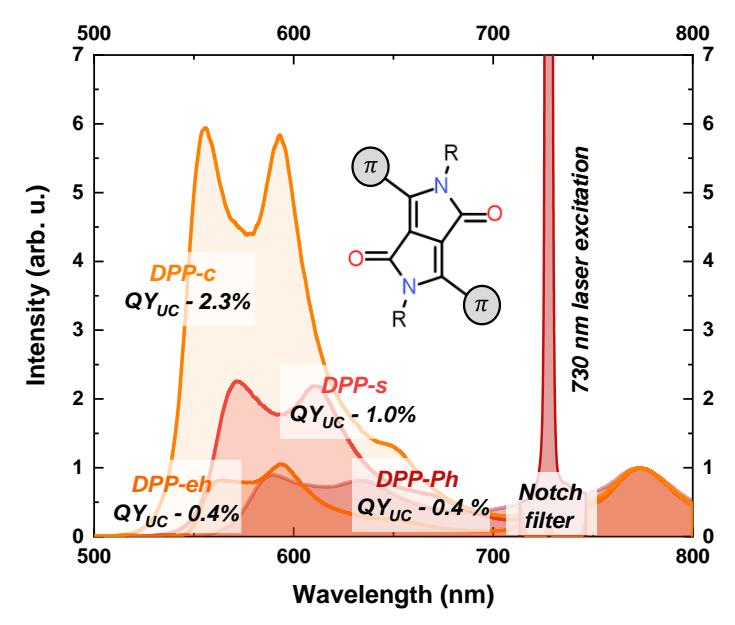
The obtained results suggest that the DPP derivatives can be considered as potential TTA emitters for solution-based applications in NIR-to-vis UC.