
Nowadays the Pulsed Electric Field (PEF) is often used method to increase the permeability of various cells and tissues, to facilitate the introduction of extracellular compounds, or cause the outflow of intracellular components [1]. The development of new, simple, fast, and reliable methods for the investigation of electroporation effects is essential to understand the mechanism of electroporation and to investigate the process of cell death after exposure to PEF.
This work was aimed to evaluate the efficiency of electroporation by amperometry using non-immobilized wild Saccharomyces cerevisiae cells. Amperometry was carried out with a BAS-Epsilon Bioanalytical system and a three-electrode cell arranged with a magnetic stirrer. Measurements were performed in 2 ml of 20 mM TRIS buffer containing 0.4 mg/ml of yeast cells (non-electroporated or exposed to single square-shaped electric field pulse with a duration of 300 μs to various electric field strengths). After the addition of two well-known mediators in bioelectrochemistry menadione and potassium ferricyanide (final concentrations, respectively, 50 μM, 0.25 mM) or both, the oxidation currents originating from menadione and potassium ferricyanide interaction with yeast cells were registered [2]. The results are summarized in Fig. 1.
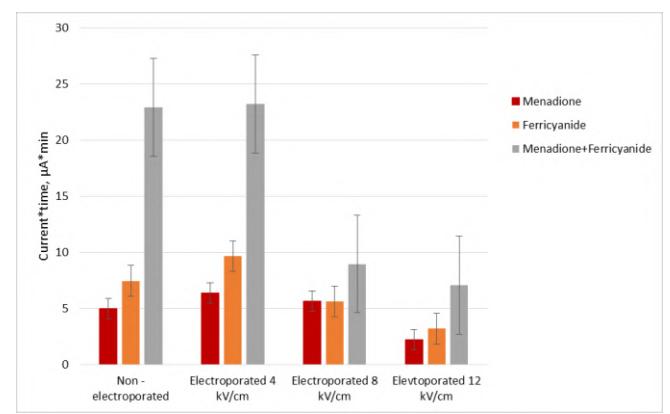
Menadione is a lipophilic mediator that penetrates inside the cell and is reduced to menadiol by several enzymes catalyzing electron transfer from NAD(P)H to a quinone. In the cases of non-electroporated cells and cells affected with 4 or 8 kV/cm, menadione-generated currents are similar suggesting that the cell membrane was not essentially damaged by electric field or electroporation was reversible. After exposure to 12 kV/cm, the 1.7-fold decrease of the currents was observed indicating possible leakage of NAD(P)H through an injured membrane. The mechanism of hydrophilic ferricyanide interaction with yeast cells is not elucidated yet. The double mediator system consisting of menadione and ferricyanide served for signal amplification. After exposure to 12 kV/cm, the ferricyanide- and both mediator-generated currents dropped as well possibly due to decreased amount of menadiol.
Conclusions: amperometry using non-immobilized yeast cells showed the difference among non-affected and electroporated cells; therefore, it was suitable to investigate the effect of electroporation of the cells; the electric fields up to 8 kV/cm practically did not have a harmful effect on yeast cells, thus, could be used for further experiments with penetration of various compounds; the decrease of menadione-generated currents could indicate the beginning of cell death after subjection to a higher electric field.