
Gestational diabetes mellitus (GD) is described as a chronic hyperglycemia diagnosed during the 2nd trimester of pregnancy and tends to disappear after delivery. This disease causes a higher risk of type 2 diabetes (T2D) for both the mother and her child, which determines its impact on global diabetes epidemic [1]. Therefore, investigation of potential molecular biomarkers for the early risk assessment of both GD and T2D development is important. Epigenetic alterations, such as expression differences of small regulatory RNAs, are among the most promising liquid-biopsy biomarkers in the context of diabetes [2].
The present study was aimed at the analysis of four miRNAs (miR-17-5p, miR-29a-3p, miR-195-5p and miR-499a-5p), which have been previously associated with particular cellular processes related to the development of diabetes [3], in a unique cohort of serial samples from women diagnosed with GD.
In total, 76 women were included in the study, of which 64 were pregnant women with GD, 7 – healthy pregnant and 5 – healthy non-pregnant women. Peripheral blood samples of the GD group (129 in total) were collected at 24–28 weeks of gestation (n = 59), from the umbilical artery (n = 21) and vein (n = 21) during the delivery, and at 6–12 weeks after delivery (n = 28). Total RNA fraction was extracted from 200 μl of whole blood and target miRNAs were quantified by means of probe-based real-time PCR.
In the GD group, higher levels of miR-17-5p and miR-195-5p were detected in blood samples collected after delivery as compared to the 2nd trimester of pregnancy (all p < 0.05, Fig. 1). Moreover, amounts of miR-17-5p, miR-29a-3p and miR-499a-5p after delivery were higher than in healthy non-pregnant women (all p < 0.05, Fig. 1). Also, miR-29a-3p level was higher in the GD group during pregnancy as compared to healthy non-pregnant women, while miR-195-5p showed the opposite difference when compared to the healthy pregnant women (both p < 0.05). Even though the majority of tested miRNAs did not show significant differences in blood from umbilical artery and vein, the level of miR-195-5p in umbilical artery in the GD group was significantly lower as compared to the group of healthy pregnant women (p = 0.04).
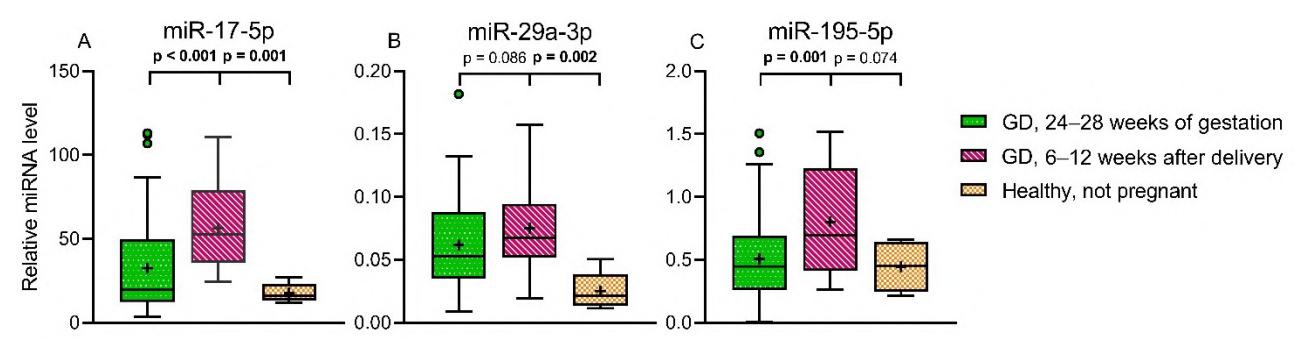
A few associations between the tested miRNAs and clinical parameters were determined. The levels of miR-17-5p and miR-29a-3p during pregnancy correlated with body mass index (both p < 0.05). Also, amounts miR-195-5p in umbilical artery and vein were associated with women's age, while the level of miR-29a-3p correlated with high- and low-density lipoproteins, respectively (all p < 0.05). Finally, the quantities of miR-17-5p and miR-499a-5p in blood from umbilical vein were associated with plasma glucose levels (both p < 0.05).
The present study revealed the differences of the tested miRNAs among the GD women and control groups as well as their associations with clinical and biochemical parameters, suggesting these miRNAs as potential biomarkers for GD. Despite that, larger independent studies would be necessary to validate these miRNAs for potential clinical applications.