
The main SARS-CoV-2 protease, Mpro, is a key enzyme in the life cycle of the coronavirus. Catalytic residues Cys145 and His41 in 3CL Mpro located in the cavity of the active site can be a potential target for molecular inhibitors. Proteins cleaved by Mpro are essential enzymes for viral replication. To inhibit Mpro and thereby stop the life cycle of the virus, it is necessary to find high-affinity ligands capable of binding in the catalytic region of its active site. [1]
Thus, the main task of this work is to search for candidates for further drug development among highly effective Mpro inhibitors. In accordance with the goal, the following tasks were set: 1. Analysis of the life cycle structure and properties of the SARS-CoV-2 coronavirus; 2. An overview of the many potential inhibitors in known publicly available libraries of chemicals; 3. Molecular docking of potential inhibitors; 4. Refinement of docking results by modeling the molecular dynamics of complexes of Mpro proteases with the best inhibitor candidates.
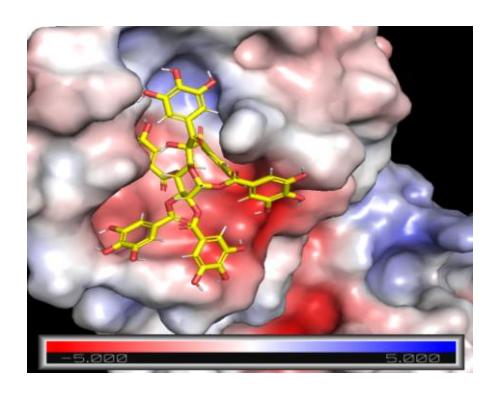
In this study using the methods of virtual screening and molecular docking in the software package Schrödinger Suites 2018-1 free energy XP Gscore of 119 482 molecules PubChem and ZINC15 free access databases were tested and evaluated. XP Gscore, calculated by the XP method, was used for compound evaluation as it provides the most accurate predictions of molecular interactions. [2] As a result we obtained 42 compounds with free binding energy ($ΔG$) values in the range from -17 to -10 kcal / mol from the category of natural polyphenol Pentagaloylglucose analogues, investigated due to the high indicators of affinity to SARS-CoV-2 Mpro protease active site observed for compound Pentagaloylglucose in similar research. [3] Among the drugs approved by world jurisdictions are 18 drugs with $ΔG$ from -13,5 to -9 kcal / mol and 37 substances with $ΔG$ from -14,3 to -10,9 kcal / mol among human metabolites, substances found in food.
10 nsec molecular dynamics simulations were performed in Gromacs for Mpro complexes with different categories of ligands selected according to the docking results. We analyzed the stability of these complexes with Mpro, the level of fluctuations of amino acid residues and interaction energies based on the RMSF and RMSD values, as well as the binding energy values (average energy of the Coulomb interaction and Lennard-Jones energy) correlate with the data of free binding energies obtained from molecular docking.
A number of ligands capable of forming complexes with the catalytic center of Mpro SARS CoV 2 were discovered during the study. Selected candidates inhibit the protease by forming a variety of chemical bonds with the catalytic dyad as well as amino acids that form the active center:VAL20, THR21, CYS22, GLY23, THR24, THR25, THR26, LEU27, ASN28, PRO39, ARG40, HID41, VAL42, CYS44, THR45, SER46, ASP48, MET49, LEU50, PRO52, TYR54, TYR118, ASN119, ILE136 SER139, PHE140, LEU141, ASN142, GLY143, SER144, CYS145. All studied ligands are non-toxic, and the resulting complexes are of interest for further study. Currently, the in silico approaches presented in this work help in repurposing already known drugs, which can significantly save time and money in the development of drugs against COVID-19.