
Bismuth vanadate (BiVO4) is one of the most promising photoanode materials for photoelectrochemical (PEC) water splitting, production of valuables chemicals and purification of wastewater. In addition to its moderate band gap (2.4-2.6eV) and ability to absorb visible light [1], bismuth vanadate is not toxic and can be formed using various synthesis techniques such as sol-gel, hydrothermal, electrochemical, etc. Synthesis method and conditions play crucial role in the formation of coatings morphology, oxygen vacancies and other defects. BiVO4 suffers from fast charge recombination between excited electron and holes, what leads to decrease of efficiency of PEC systems. Charge recombination could be due to many factors, such as defects, oxygen vacancies, grain boundaries, particle size, etc., therefore careful optimization of synthesis is necessary [2]. In this work bismuth vanadate was synthesized using sol-gel approach and dip-coating technique. We investigated how annealing temperature influences formation and PEC performance of bismuth vanadate. XRD, SEM analysis was used for structure and morphology evaluation, respectively. Photoelectrochemical activity of the coatings was evaluated using cyclic voltammetry (CV), electrochemical impedance spectroscopy (EIS) and Mott-Schottky analysis.
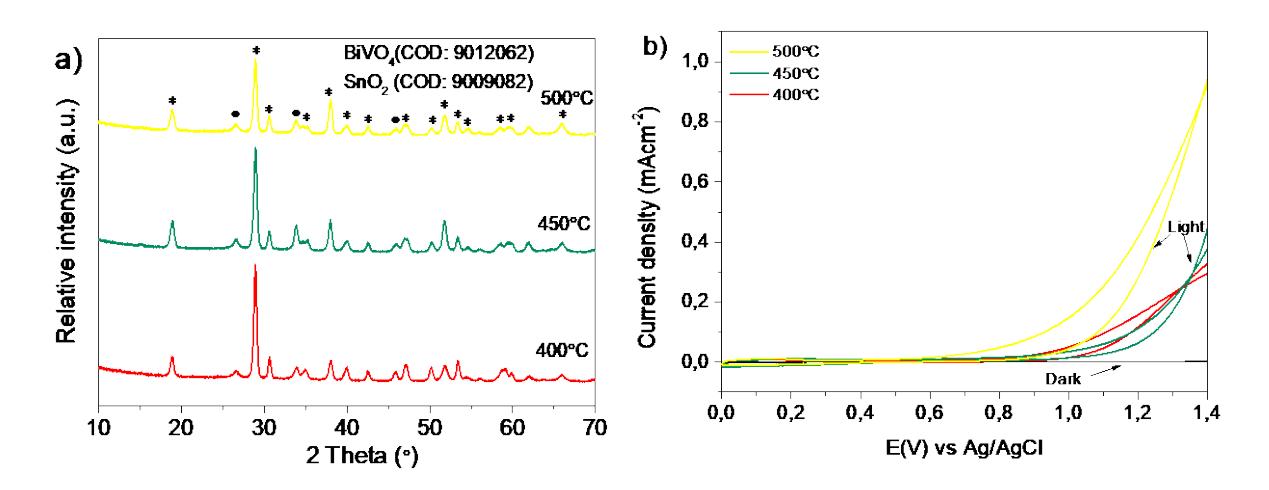
XRD results (Fig. 1a) showed that tetragonal structure of BiVO4 is already formed at 400°C. Values of FWHM (full width at half maximum) of peak at 2θ=28,9° are very similar for all samples, implying identical crystallinity and similar size of crystallites. SEM analysis showed that different annealing temperature leads to formation of different morphology of coatings. CV results confirmed that annealing temperature has strong influence to photoelectrochemical activity of the films (Fig. 1b). The highest photocurrent (~0.9 mAcm-2) was obtained in the case of coating annealed at 500°C, whereas samples annealed at 400°C and 450°C yielded photocurrent of 0.3-0.4 mA cm-2. EIS investigations and Mott-Schottky analysis were performed for deeper analysis of the synthesized coatings.