
The world's energy crisis led to the investigation and improvement of renewable energy sources. Sodium borohydride (NaBH4) is the main anodic fuel in the direct borohydride fuel cells (DBFCs). These electrochemical devices operate with alkaline anolyte and catholyte with oxygen (O2) as the oxidant. Borohydride oxidation reaction (BOR) occurs by the next equation (1) where eight electrons are released per mol of BH4- [1-3]:
$$BH_4 + 8OH \rightarrow BO_2 + 6H_2O + 8e \quad E^\circ = 1.24 \text{ V vs. SHE}\tag{1}$$In this study, the nanosized gold silver particles supported on reduced graphene oxide (AuAg/rGO) were prepared by the modified recipe given in ref [4]. In the first step, reduced graphene oxide was prepared by adapting Hummer's method and then was mixed with silver and gold salts [4]. The final product was obtained by adding reducing agent L-AA with NaBH4 [4].
Transmission electron microscopy (TEM) and scanning electron microscope with integrated energy-dispersive X-ray spectroscopy (SEM-EDS) were used for the determination morphology and metal content of AuAg/rGO electrode. Nanosized metal sphere particles were noticed at the gray surface of rGO by both SEM and TEM analysis. Particle size distribution obtained by TEM analysis showed low average diameters of the AuAg/rGO particles up to 2 nm. Au and Ag content of 25 and 52 mass %, respectively, were determined by EDS analysis in AuAg/rGO.
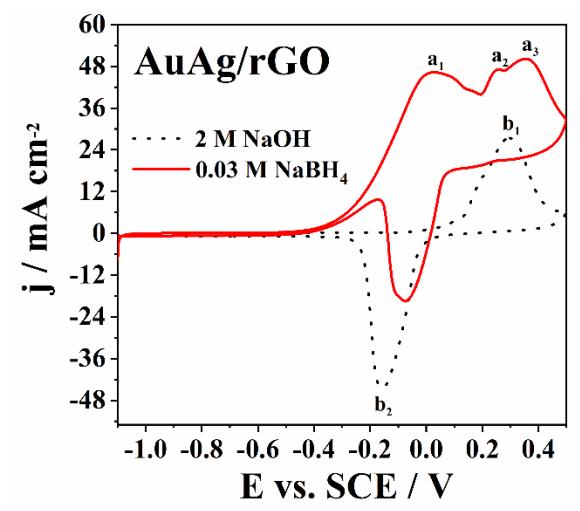
Then, AuAg/rGO was examined in 2 M NaOH and 0.03 M NaBH4 + 2 M NaOH (Fig. 1) by cyclic voltammetry (CV). $b_1$ and $b_2$ peaks of AuAg/rGO were seen at 0.3 and -0.2 V in 2 M NaOH correspond to Ag2O formation and reduction, respectively [5]. Additional well-defined $a_1$, $a_2$, and $a_3$ anodic peaks were noticed at 0.02, 0.2, and 0.4 V, respectively, in the NaBH4 solution. These peaks clearly showed that AuAg/rGO electrode is active for direct BOR (peak $a_3$) as well as for oxidation of BH4- hydrolysis products, eg. BH3OH- ion (peaks $a_1$ and $a_2$) [1-3]. Namely, BH4- hydrolysis often proceeds simultaneously with its direct oxidation, thus reducing fuel utilization.
This appearance and high current densities of three anodic peaks (especially peak a1) suggest the high catalytic activity of AuAg/rGO electrode for BOR.