
Unconventional laser beams have an increasing demand in laser micro-processing of transparent material. One of such unconventional laser beams is an Airy beam. The main advantage of the Airy beam is that its intensity distribution can be controlled both in the direction of the propagation axis and in the cross-section. This feature allows for the generation of an Airy beam with desired parameters.
The solution of the Schrödinger equation for a free particle may be mathematically defined using the Airy function [1]. The Fourier transform of this wave packet gives the following expression for the spatial spectra [2]:
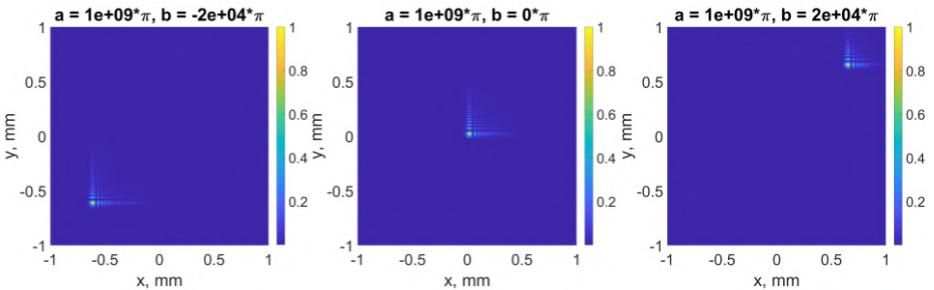
$$\widetilde{\varphi}(k_x, k_y) = A_0 e^{-a(k_x^2 + k_y^2)} \exp\left(i\frac{k_x^3 + k_y^3}{3}\right),\tag{1}$$where A0 is the normalization constant and kx, ky are spatial frequencies for x and y coordinates. Thus, in order to obtain an Airy beam, it is only necessary to modulate the Gaussian beam with a cubic phase and perform a Fourier transform. By adding a linear term to the cubic phase mask, the position of the central maxima of the Airy beam can be flexibly positioned in a transverse plane. The expression for the phase mask is as follows:
$$T = e^{-i[a(x^3+y^3)+b(x+y)]},\tag{2}$$where a is a constant denoting the period of the cubic phase and b is a constant denoting the slope of the linear phase. The Airy beam can be flexibly adjusted by changing the value of b, see Fig. 1
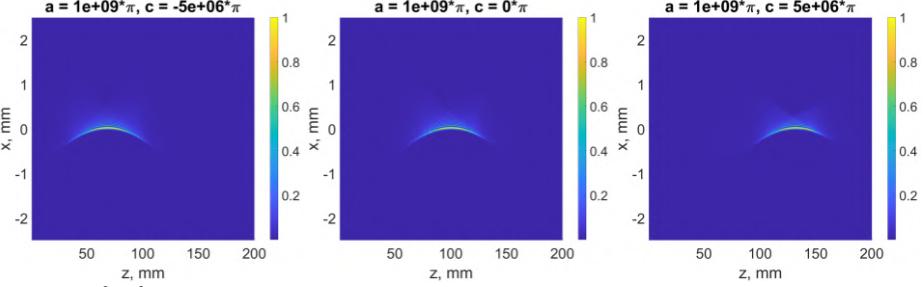
The Airy beam can also be flexibly positioned with respect to the direction of propagation by adding a parabolic term to the cubic phase mask. The expression of the phase mask is described as follows:
$$T = e^{-i[a(x^3+y^3)+c(x^2+y^2)]},\tag{3}$$Here c is a constant describing the slope of the phase delay. The Airy beam can be controlled by varying the value of the coefficient c, see Fig. 2
These approaches help to generate a non-diffractive Airy beam with flexibly adjusted properties of the central intensity lobe.