
In recent years green strategies trend may lead to a redistribution of BC sources, as the contribution of BC from wood burning would increase [1]. Urban trees can offer great potential to remove PM and other air pollutants, especially nearby sources, by absorbing gaseous air pollutants through their stomata and trapping PM on the leaf surface [2][3]. Thus, reducing BC emissions could provide climatic and human health benefits in the coming decades[4].The purpose of the study is to consider the role of urban trees on the removal of BC by common spruce and birch, as well as on the formation of BC, mass concentration and distribution of sources.
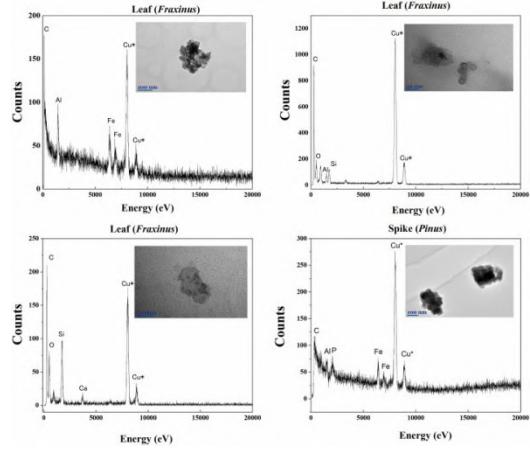
Measurements were performed during July-October 2020at an urban background station in Vilnius (capital of Lithuania).The aethalometer (A Magee Scientific Company Aethalometer model AE31) provided continuous real-time measurements of BC mass concentration.Transmission electron microscopy (Tecnai G2 F20 X-TWIN, resolution 0.25-0.102 nm) in combination with energy scattering X-ray spectroscopy (EDX) was used to characterize and obtain detailed information on the morphology, size, and elemental composition of individual aerosol particles deposited on leaf of silver birch (Betula pendula Roth) and needle of Scots pine (Pinus sylvestris L.). BC aerosol particles were found in all samples of leaves and needles as a result of the deposition.The largest agglomerate of the detected BC particles had a length of 288.5 nm and a width of 220.4 nm. The diameter of primary particles ranged from 24.2 to 30.0 nm on leaves of silver birch, and from 32.45 to 44.13 nm on spruce needles (Fig.1). Larger agglomerates were found on the needles of conifers than on deciduous trees, as they form a thicker epicuticular waxy layer and accumulate BC more efficiently.This study showed a significant contribution of transport (54%) and combustion of firewood and agrobiomass to BC emissions during the warm season in the urban background zone from June to October 2020.
This work was carried out in the framework of the project "Investigation of aerosol black carbon emissions from biomass incineration units and deposition on tree foliage" (RTO Lithuania).