
Air pollution is the single largest environmental health risk in Europe [1, 2], as well as a complex problem causing diverse challenges in the field of management and mitigation of harmful pollutants [3]. Indoor air pollution is the main problem for people living in urban areas because they spent almost 90% of their daily time indoor [4]. In 2019, the World Health Organization revealed that indoor air pollution killed the lives of 3.8 million people exposed to air pollution [5].
Concentration and outdoor/indoor (O/I) ratio of trace metals in the outdoor/indoor environments are presented. The concentrations of 17 elements, including Al, Si, P, Cl, K, Ca, Sc, Ti, V, Cr, Mn, Fe, Co, Ni, Cu and Zn in PM1 (PM1 – particulate matter, particle with aerodynamic diameter < 1 μm) were determined (Fig. 1). Trace elements, which are presented in this research as the constituents of PM1, are emitted mainly by anthropogenic activities (power generation, industry and transport sectors) [3]. The combustion of fuels is the main source of sulphur (in the form of sulphur dioxide (SO2)) if it is enriched with this element [3].
The aim of this study is to examine the O/I ratios of these trace elements during November 2020 – July 2021. Outdoor PM1 filter samples (PTFE and PCTE) were collected using a low volume sampler (SVEN LECKEL, LVS6) with sampling frequency 2-3 times a week located on the roof of a 4-floor building (Center for Physical Sciences and Technology, FTMC (Vilnius, urban background site)) and indoor. The quantitative analysis of multielemental contents in PM1 was performed using the Particle-Induced X-ray emission analysis detector CANBERRA SL30165 and the analyzer CANBERRA DSA1000.
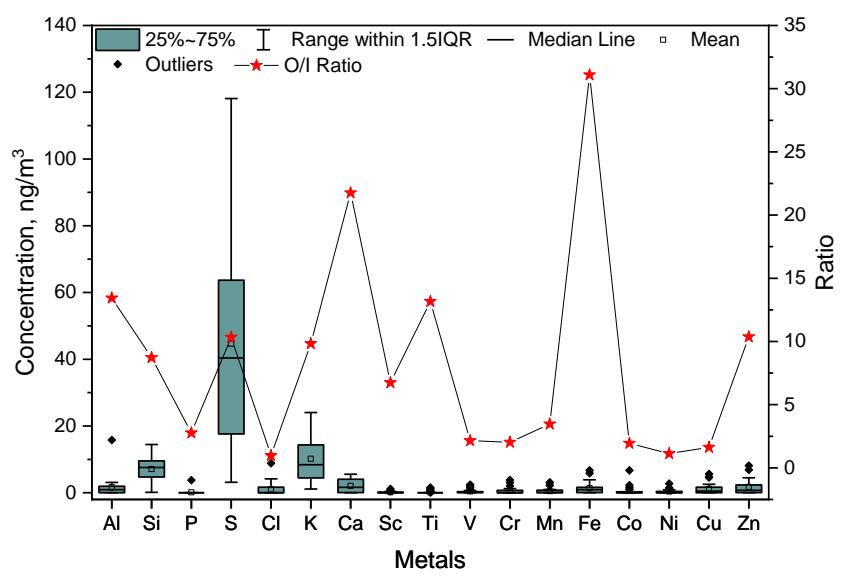
Based on the results, the aerosol particles of PM1 containing higher amounts of Al, Si, S, K, Ca, Ti, Fe and Zn are more effectively trapped by air filters, therefore these elements are detected in much lower concentrations in indoor air. Accordingly, the O/I ratio of these elements are the highest. The average mass concentrations of all elements in indoor air fluctuate from 0.15 ng/m3 (phosphorus, P) to 44.67 ng/m3 (sulphur, S).
The study of PM1 constituents can provide an additional information about sources of air pollution. Comprehensive knowledge about air pollutants and their constituents, their transportation and transformation in the atmosphere is necessary in order to reduce their impact on human health, ecosystems and the climate [3].