The design and wide application of electrochemical biosensors in nanoscience, nanotechnology, medicine, pharmaceutics industry, environmental and food monitoring significantly increased during the past decade [1,2]. The research community is working to develop effective tools for diabetes management and diagnosis, because diagnosed for seven million people every year diabetes mellitus is considered a worldwide public health problem (the risk of heart disease, kidney failure, blindness, postoperative and wound infections) [2,3]. Last time such $\pi$-$\pi$conjugated polymers as polyaniline (PANI), polypyrrole are becoming an integral part of biomolecules immobilization strategies and electrochemical sensor platforms [1,4]. During the enzyme-assisted formation of $\pi$-$\pi$conjugated polymers, the monomer is attacked by a radical cation induced by H2O2 [5]. Combined with electroactive gold nanoparticles (AuNPs) and enzyme polyaniline is suitable for the development of biosensors dedicated for the monitoring of glucose due their positive effect on the sensitivity and selectivity [1,6].
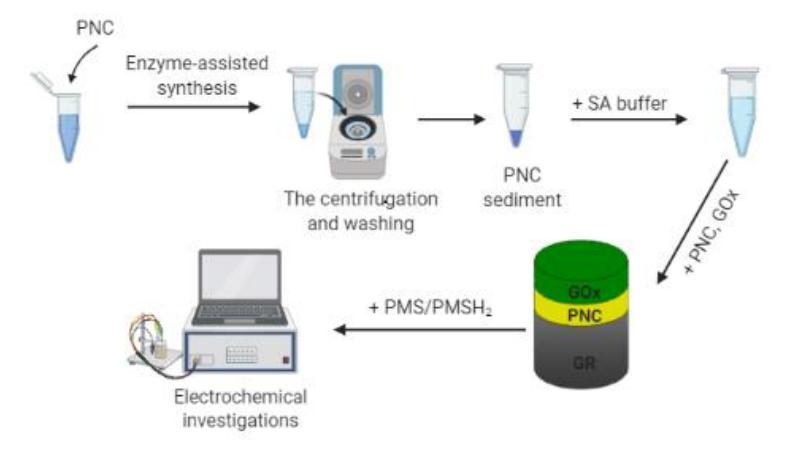
The main aim of this research was to compare analytical characteristics of glucose biosensors modified by enzyme-assisted polymeric nanocomposites (PNC) with embedded enzyme enzyme (glucose oxidase (GOx)) without/with 6 nm of gold nanoparticles. Firstly, polyaniline nanocomposites with GOx (PANI-GOx) without and with AuNPs (PANI-GOx-AuNPs) were synthesized by enzyme-assisted polymerization, washed, separated and dispersed in the solution of sodium acetate (SA) buffer (Fig. 1). Then, graphite rod (GR) electrode was immobilized by described above kind of polyaniline nanocomposites with following addition of GOx. Electrochemical investigations were performed by cyclic voltammetry (CV) and chronoamperometry (ChA) in the presence of red-ox mediator phenazine methosulfate (PMS). The reversibility of electrochemical reaction was evaluated by CV, the analytical characteristics, stability and selectivity – by ChA. It was investigated that the biosensor based on GR/PANI-GOx-AuNPs/GOx has been found more efficient than an analogous electrode coated with PANI-GOx nanocomposites. Developed glucose biosensors based on GR/PANI-GOx/GOx and GR/PANI-GOx-AuNPs/GOx electrodes were characterized by high sensitivity (52.0 and 65.4 µA mM-1 cm-2), low detection limit (0.084 or 0.070 mmol/L), wide linear concentration range (till 16.5 mmol/L), good correlation coefficient (0.9936 or 0.9968) and repeatability (6.10 and 4.67 %), appropriate stability (17 and 22 days). Biosensor based on GR/PANI-GOx-AuNPs/GOx electrode presented the excellent anti-interference ability to ascorbic and uric acids, successful practical application for glucose determination in serum.