
Microbial biofilms cause up to 80% of all human bacterial and fungal infections [1]. Pathogens producing biofilm are particularly resistant to antibiotic treatment, so there is a need to look for new treatments and prevention methods. Antimicrobial photodynamic therapy (aPDT) can be applied for the treatment of infectious diseases. The aPDT uses non-toxic dyes, also called photosensitizers (PS), which are excited by harmless visible light and can form reactive oxygen species that attack adjacent targets, including proteins, lipids, and nucleic acids, in the biofilm matrix, on the cell surface, and inside microbial cells. Damage to non-specific targets destroys both planktonic cells and biofilms [2]. Fullerenes have received considerable attention due to their good quantum yields [3]. The aim of this study is to attach fullerenes on polylactic acid surface for aPDT use.
Polylactic acid surface was modified 3 different ways before reaction with fullerene: with ethylenediamine (EDA), phosphorus pentachloride (PCl5), and phosphorus pentachloride and EDA.
XPS analysis was used to obtain information on the chemical states and surface composition of the elements. After reactions with EDA atomic nitrogen increased and a new peak at 398.6 eV in the N1 spectrum was observed, which indicates a new bond formation. In reactions with phosphorus pentachloride the measured amount of atomic chlorine increased. After the reaction with fullerene, an atomic carbon content increased and a new peak appeared at 289 eV, which corresponds with ${\pi}$-${\pi}$ bonds deriving out of fullerene.
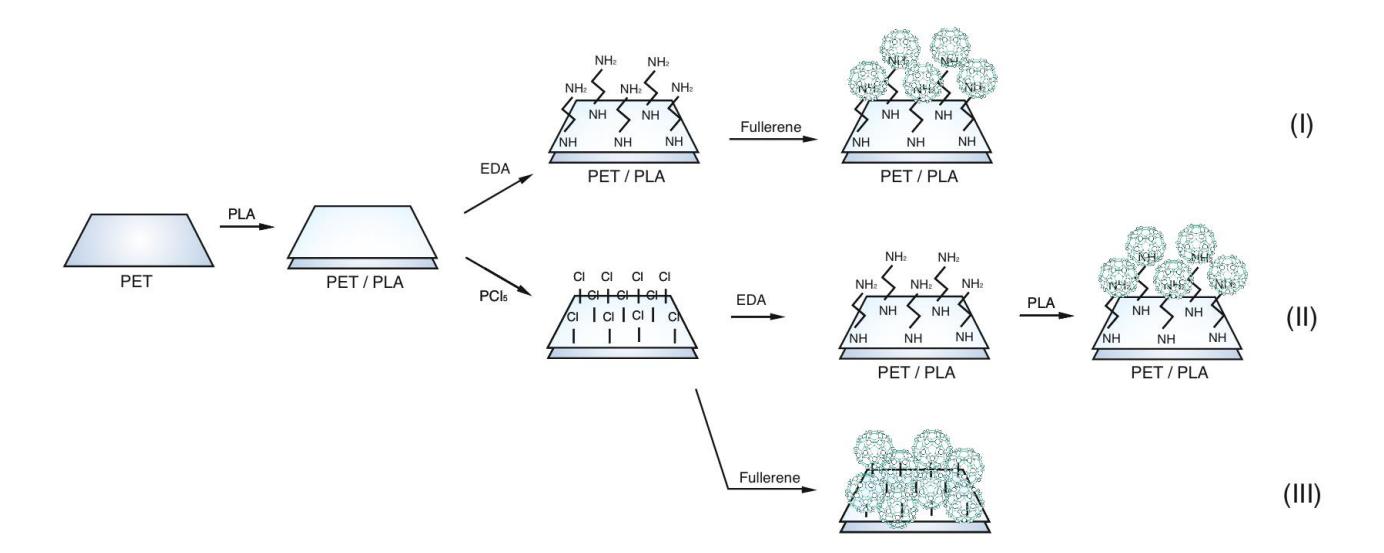
In conclusion, fullerene precipitation on modified PLA surface was evaluated by XPS analysis as an increase of carbon content. In Fig. 1 after (I) synthesis carbon content increased 12.6%, in (II) synthesis – 6.9%, and the highest carbon increase was observed in (III) synthesis - 22.8%. To conclude, polylactic acid modified with fullerene could later be used in aPDT. Nevertheless, antimicrobial polymer could potentially be applied in different fields, for example, health care and medical devices.