DETECTION OF NITROBENZENE DERIVATIVES USING SILVER COPPER ELECTRODE ON REDUCED GRAPHENE OXIDE IN NEUTRAL MEDIA
Aleksandar M. Đorđević1, 2, Jadranka Milikić3, Biljana Šljukić3
1 University of Belgrade, Institute of General and Physical Chemistry, Studentski trg 12/V, 11158 Belgrade, Serbia
2 University of Belgrade, Faculty of Chemistry, Studentski trg 12–16, 11158 Belgrade, Serbia
3 University of Belgrade, Faculty of Physical Chemistry, Studentski trg 12-16, 11158 Belgrade, Serbia
In recent years, environmental pollution caused by the disposal of industrial waste has been a serious problem. Aromatic nitro compounds stand out among the pollutants that are very harmful to human health. They are organic pollutants in wastewater from various industrial processes such as the paint and varnish industry, explosives, perfumes, plastics, pesticides, and the pharmaceutical industry [1-3]. They are classified as highly toxic and carcinogenic, showing carcinogenic activity even at trace levels, especially nitrobenzene (NB) and its derivatives [2-5]. Therefore, detection of NB is vital for the protection of human health and the environment [5]. Within the present study, novel electrode materials were developed for application in the electrochemical sensor for the detection of NB in neutral media.
Herein silver copper supported on reduced graphene oxide (AgCu/rGO) was characterized by transmission electron microscopy (TEM) and scanning electron microscopy (SEM) where nanosized spherical metal particles distributed on a grey surface of rGO were seen.
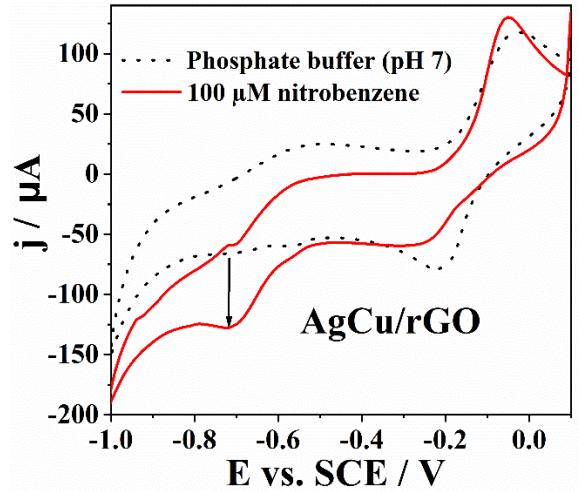
Fig. 1. Cyclic voltammograms of AgCu/rGO recorded in the absence (•••) and presence (—) of 100 μM nitrobenzene in 0.1 M phosphate buffer (pH 7) saturated with N2 at a scan rate of 10 mV s-1.
The electrochemical behavior of AgCu/rGO nanocomposites in NB solution was studied by cyclic voltammetry (CV). Fig. 1 shows that the control cyclic voltammogram of AgCu/rGO electrode recorded in 0.1 M phosphate buffer doesn't show peaks in the potential range where the NB reduction reaction is expected, while the cyclic voltammogram recorded in 100 μM NB shows a reduction peak of NB at a potential of about - 0.7 V. A similar response to the presence of NB in a neutral medium was shown by silver nanoparticles (Ag NPs) deposited on spheres of modified silica (SiO2) [4]. The results showed electrodes' good sensitivity to the presence of NB. AgCu/rGO electrode could be a promising sensor for NB detection in neutral media because of its low cost and fast synthesis.
Acknowledgments: The authors would like to thank the Ministry of Education, Science and Technological Development of the Republic of Serbia (contract no. 451-03-9/2021-14/200146; 451-03-9/2021-14/200051 and 451-03-9/2021-14/200168).
[1] S.-S. Li, J.-H. Fang, L. Li et al., An ultra-sensitive electrochemical sensor of Ni/Fe-LDH toward nitrobenzene with the assistance of surface functionalization engineering, Talanta225, 122087 (2021).
[2] J. Liu, R. Ye, J. Shi, et al., Construction of Cu nanoparticles embedded nitrogen-doped carbon derived from biomass for highly boosting the nitrobenzene reduction: An experimental and theoretical understanding, Chemical Engineering Journal419, 129640 (2021).
[3] A. Nematollahzadeh, A. Babapoor, S. M. Mousavi, et al., Nitrobenzene adsorption from aqueous solution onto polythiophene-modified magnetite nanoparticles, Materials Chemistry and Physics262, 124266 (2021).
[4] P. Rameshkumar, R. Ramaraj, Electroanalysis of nitrobenzene derivatives and nitrite ions using silver nanoparticles deposited silica spheres modified electrode, Journal of Electroanalytical Chemistry731, 72-77 (2014).
[5] C. Karuppiah, K. Muthupandi, S.-M. Chen, et al., Green synthesized silver nanoparticles decorated on reduced graphene oxide for enhanced electrochemical sensing of nitrobenzene in waste water samples, RSC Advances5, 31139-31146 (2015).