Vanillin can be extracted from vanilla orchids or obtained by chemical modification of lignin. Vanillin produced by chemical modification of lignin is considered natural vanillin and is 250 times cheaper than synthetic vanillin. Due to the aromatic structure, it could be able to replace widely used petroleum-based aromatic monomers [1]. Recently, vanillin and its derivatives have attracted a great deal of attention as renewable building blocks for high-performance polymers mainly due to their rigid aromatic structures [2].
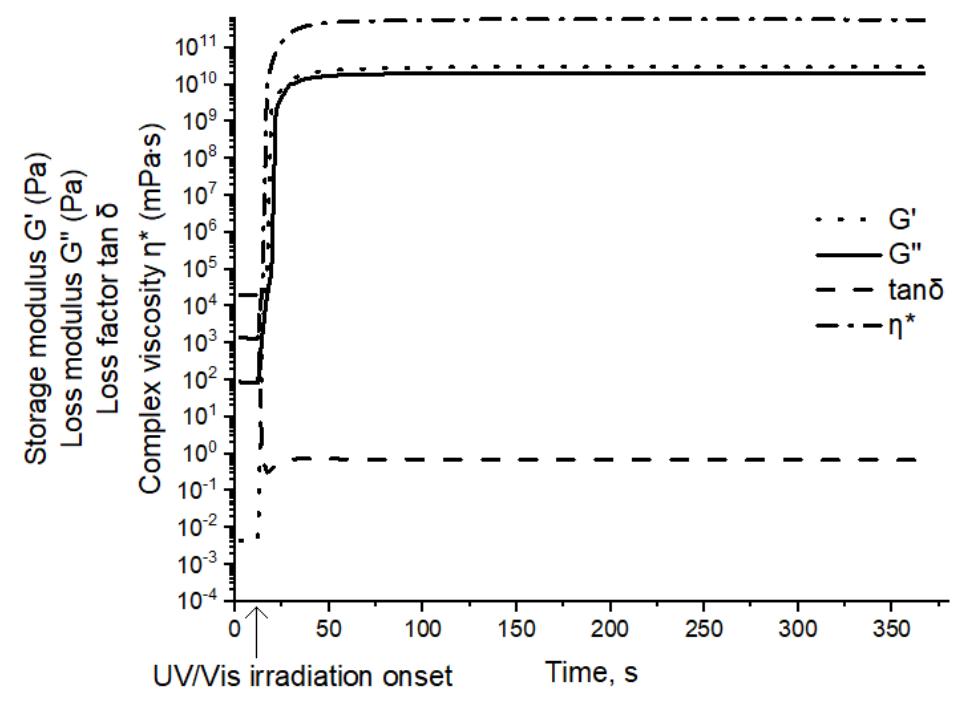
In this study, commercially available vanillin derivatives were used in photoresins to find efficient photocurable systems for the production of cross-linked polymers with excellent mechanical properties. Real-time photorheometry was used to monitor the evolution of the photocross-linking process. As an example, the dependencies of the storage modulus G', the loss modulus G', loss factor $tan\delta$, and the complex viscosity $\eta^*$ of the vanillin-based resin on the irradiation time are presented in Figure 1. When resin irradiation started, the values of storage modulus G', loss modulus G', and complex viscosity $\eta^*$ started to increase, indicating the beginning of the cross-linking process. The onset of the gelation process is described as the gel point ($t_{gel}$), that is, the point at which the G' and G'' modulus curves intersect is defined as [3]. As the resin irradiation of the resin proceeded with time, the values of G', G'' modulus, and $\eta^*$ continued to increase due to gel aging and settled down in a steady state, indicating the end of the cross-linking process. All vanillin-based resins investigated in this study showed similar behavior. The dependence of the addition of various comonomers and their concentration in the photoresin composition on the photocuring kinetics and rheological characteristics was investigated.