Cellular viscosity is a crucial parameter that controls diffusion-mediated processes, such as protein interactions, signal transduction, transport of small organic molecules and others. Distortions in viscosity of the cell have been linked to multiple pathologies: diabetes, Alzheimer's disease, and atherosclerosis [1]. Fluorescent viscosity probes are a promising tool that could allow an effective way to measure cellular viscosity, significantly contributing to the elucidation of the mentioned diseases. Meso-phenyl BODIPY dyes are widely used as viscosity sensing probes because of their photostability and excellent photophysical properties. The main mechanism of their action is a non-radiative relaxation by rotation of the phenyl ring after the dye is excited with light. In more viscous media the rotation is suppressed leading to the increase of the fluorescence lifetime. Because meso-phenyl BODIPY dyes have mono-exponential lifetimes they can be used in FLIM (fluorescence lifetime imaging viscosity) to map cellular viscosity [1]. On the other hand, it has been noticed that meso-phenyl BODIPY also shows sensitivity to environmental polarity [2], which makes it more difficult to produce accurate measurements. Thus, we sought out to create a selective viscosity probe that would be based on the same BODIPY platform containing its great properties but bearing a formyl- rotating group. The introduction of the aldehyde group instead of the phenyl ring produces a change in the photophysical mechanism of the fluorophore, its rotation around C-C bond creates steric hindrances causing the bending of the dipyrrin scaffold, which means that in a low-viscosity environment the dye relaxes by a nonradiative manner [3]. One such fluorophore was reported as a successful probe for cellular viscosity [3] but its emission was green which is not the best option for use in biological samples. Red-emitting fluorophores are sought out because they offer better penetration of biological objects and decrease the probability of autofluorescence [4].
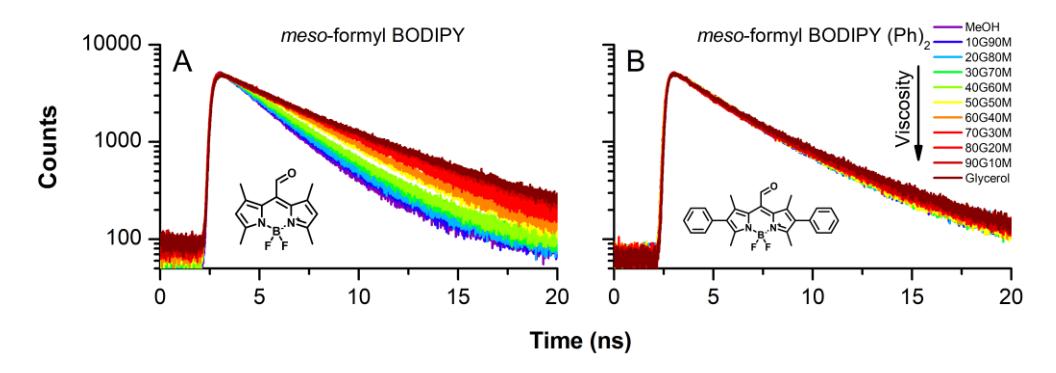
Thus, herein we report a meso-formyl BODIPY that is modified with phenyl rings at the 2,6-positions of the BODIPY scaffold to extend the conjugation of the system and move its fluorescence to longer wavelengths. Comparison of fluorescence lifetimes in solvent mixtures of different polarity and viscosity provides us with the conclusion that meso-formyl BODIPY (Ph)2 is insensitive to differences of environmental polarity, but it also loses its sensitivity to viscosity when the probe is additionally modified with phenyl rings at the 2,6-positions (Fig. 1). This might be caused by both electronic effects and steric hindrance produced by the phenyls on the boron-dipyrromethene scaffold.
In conclusion, maintaining meso-formyl BODIPY sensitivity to viscosity while at the same time extending its conjugation is a complicated problem that needs to be tackled by both theoretical calculations and experimental investigations.