
Pathogenic microorganisms can cause infectious diseases and complication of these diseases endangered humans' life. For a long time, it was believed that fungi do not affect infections which are caused by bacteria, but with the development of diagnostic equipment and more research, it has been observed that interaction between bacteria and fungi may worsen patient's condition. Antibiotics are used for the treatment of bacterial infections and antifungals for the yeast caused infections. It is known that bacteria can develop antibiotic resistance while fungi are not sensitive for the treatment by antibiotics and vice versa. In mixed infections, only one domain of pathogenic microorganism (eukaryote or procaryote) can be killed while allowing another to spread even faster. Methods which are used nowadays for pathogenic microorganisms' identification requires sample preparation and/or cultivation and takes a long time until the identification results are obtained, especially in the case of eukaryotic microorganisms. ATR IR spectroscopy is a non-destructive method and often does not require sample preparation. The collection of the ATR IR absorption spectrum takes several minutes therefore the identification of pathogenic microorganisms can be accomplished faster [1-3].
In this work, the method of an attenuated total reflection of infrared radiation (ATR IR) spectroscopy was applied for the analysis. ATR IR absorption spectra of 150 samples of different bacteria (57 samples, 8 different species) and fungi (93 samples, 3 different species) were analyzed.
The main differences between bacteria and fungi ATR IR absorption spectra were observed in the 1800 cm-1 – 750 cm-1 spectral region which is associated with carbohydrates in bacterial and fungal cells. Also, a change in the contour of the spectra is observed in the 1360 cm-1 – 1280 cm-1 spectral region. Fig. 1 shows ATR IR absorption spectra of different species of bacteria and fungi.
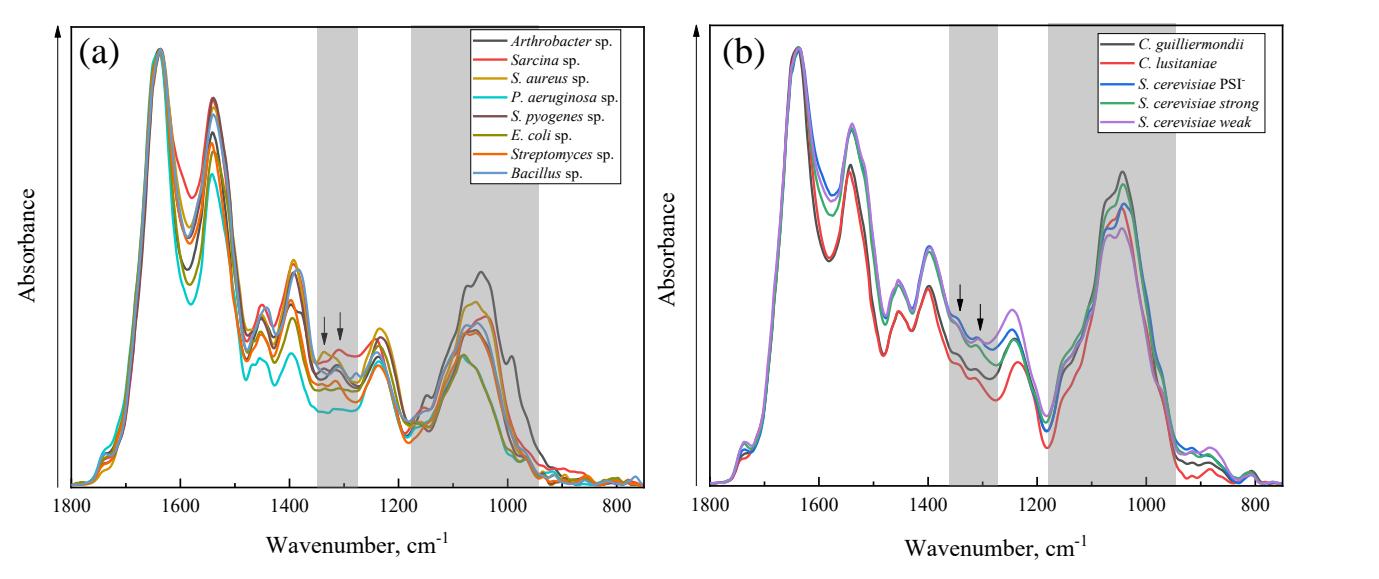
In this work hierarchical cluster analysis (HCA) and principal component analysis (PCA) were applied to determine how accurately bacteria and fungi ATR IR absorption spectra can be identified. HCA showed that the ATR IR absorption spectra of bacteria can be identified with 89,9 % accuracy and the ATR IR absorption spectra of fungi can be identified with 100 % accuracy. Six Arthrobacter sp. ATR IR spectra were assigned to the incorrect group. PCA showed that the ATR IR absorption spectra of bacteria can be identified with 91,2 % accuracy and the ATR IR absorption spectra of fungi can be identified with 100 % accuracy. PCA diagram showed that five Arthrobacter sp. ATR IR spectra were assigned to the incorrect group.
All in all, ATR IR spectroscopy is a suitable method for the identification of different pathogenic microorganisms. In order to apply the method for clinical diagnostics it is important to carry out studies with larger sample number and to continue to use both methods of statistical analysis.