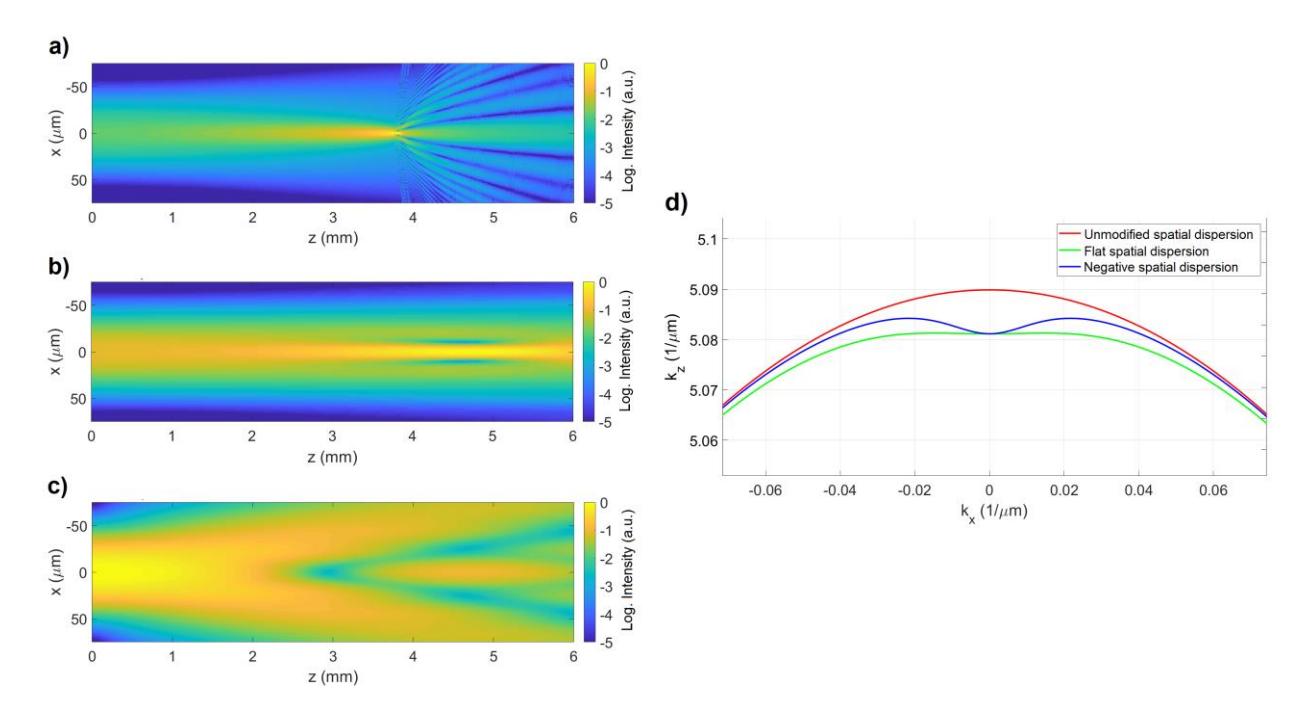
Femtosecond light filamentation is a common process that occurs during laser beam propagation through a nonlinear material. During this process, light self-focusses in to a very long, but small diameter zone, that exhibits crystal degradation due to plasma generation and color centers formation. In order to avoid these unwanted effects it is often beneficial to partially or even completely suppress the effect of self-focusing. It is demonstrated that for this purpose we can use light manipulating devices – photonic crystals [1]. Suppression of filamentation can be very beneficial for supercontinuum (SC) generation in bulk materials, as it could stop crystal degradation and prolong the SC lifetime.
In this work, we numerically model nonlinear laser beam propagation through modified spatial dispersion materials – photonic crystals. It is demonstrated that, beam propagation is dependent on the shape and radius of spatial dispersion curves. A few distinct modes of beam propagation can be distinguished: diffraction, antidiffraction and self-collimation (as shown in Fig. 1). Filamentation usually occurs in photonic crystals that exhibit positive spatial dispersion (diffractive materials). Complete suppression of filamentation can be seen in negative spatial dispersion photonic crystals (antidiffractive materials). We demonstrate that a crystal exhibiting flat spatial dispersion, can be used to suppress filamentation, but still maintain a partially collimated light beam propagation. Calculated total on axis nonlinear shift (also known as B integral) shows us that suppressed filamentation maintains a very similar amount of nonlinear phase shift when compared to beam propagation with filamentation. This result indicates that in photonic crystals that exhibit flat spatial dispersion we can expect a very similar amount of self-phase modulation, which could lead to a similar spectral broadening. At the same time largest achievable laser light intensity (at beam waist) is almost an order of magnitude lower.