
Bee pollen is pollen collected from various plants by bees and stuck together by nectar and enzymes, such as amylase and catalase, and then formed into granules. Bee pollen is rich in a plethora of nutrients such as phenolic compounds, minerals, and vitamins which can improve the health of humans [1]. Great things never come cheap, the same is with bee pollen. The main flaw of bee pollen is that they have a wall named exine which is made from sporopollenin, this kind of wall is extremely elastic, sturdy, and resilient to chemicals. Due to the exine wall resilience, humans only digest only about 10-15% of bee pollen [2].
Fermentation is recommended to increase the bioavailability of bee pollen. In this project, bee pollen was fermented using symbiotic cultures of bacteria and yeast which are naturally present in tibico and kombucha cultures. Prepared tibico and kombucha drinks were used to ferment bee pollen. One random sample from Lithuania was selected in order to optimize the ratio of bee pollen and tibico/kombucha drink and the fermentation time required to extract the highest amount of phenolic compounds and flavonoids. Spontaneous fermentation without the addition of tibico or kombucha drink was performed for comparison. After 3 or 8 days of fermentation, methanolic extracts from fermented pollen mass were prepared and tested for the total amount of phenolic compounds and flavonoids. Results are presented in the Fig. 1.
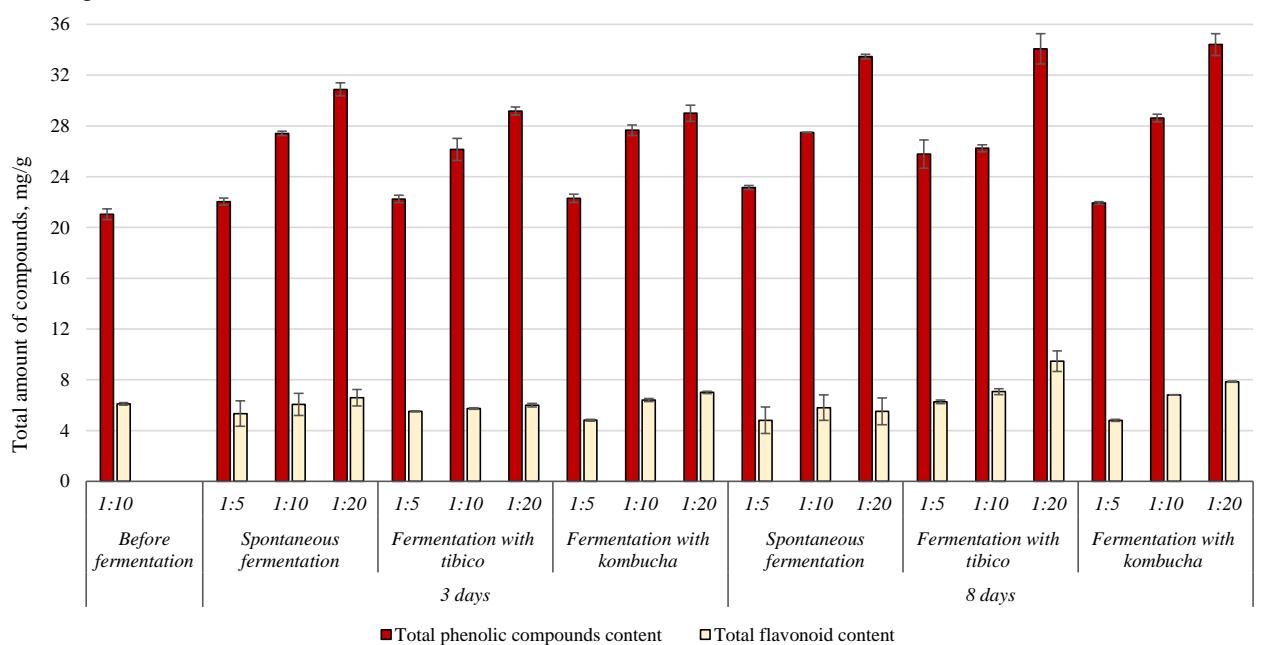
As it can be seen, both spontaneous fermentation and fermentation with tibico or kombucha cultures had a positive effect, mainly on the total content of phenolic compounds. However spontaneous fermentation showed similar results to tibico/kombucha, but in the samples of spontaneous fermentation the growth of molds is evident after 2-3 days and due to that they became unusable for consumption. The highest amount of phenolic compounds were extracted after 8 days of fermentation both with tibico and kombucha cultures at the 1:20 ratio 34.1±1.2 mg/g and 34.4±0.9 mg/g, respectively. The highest amount of flavonoids was also extracted after 8 days of fermentation at the 1:20 ratio: 9.5±0.8 mg/g and 7.9±0.1 mg/g using tibico and kombucha cultures, respectively.
The performed study showed, that the highest amount of phenolic compounds and flavonoids is achieved after 8 days of fermentation at room temperature using a 1:20 ratio (1 gram of bee pollen and 20 ml of the fermented drink).