Improper disposal of heavy metals and chemicals used in the battery manufacturing process highly contributes to the pollution of the environment, solution to that could be ambient energy harvesters. For a long time, our ability to harvest energy from natural sources on a small scale was limited due to inefficient electronic components and lack of power storing options, but nowadays availability of ultra-low barrier radio frequency (RF) diodes, and specialized chipsets enables us to develop highly efficient harvesters.
In this paper, we are investigating RF energy harvesting in Wi-Fi band to power one sensor wireless network without using batteries. The energy harvesting system consists of an RF power source, antenna, matching network, rectifier, and power managing system. Due to the growing number of wireless signals like Wi-Fi networks and mobile phones, RF energy is widely available. However, it suffers from low energy density due to free space path loss. To reach higher efficiency multiple antenna arrays could be used.
We chose to use a dual-band (2.45 GHz and 5.1 GHz) patch antenna for this project due to its low directivity and relatively simple manufacturing process. At first, we modeled it using finite-difference time-domain (FDTD) method, then etched the pattern of the antenna on a plate of Rogers RT5880 with a laser cutting machine.
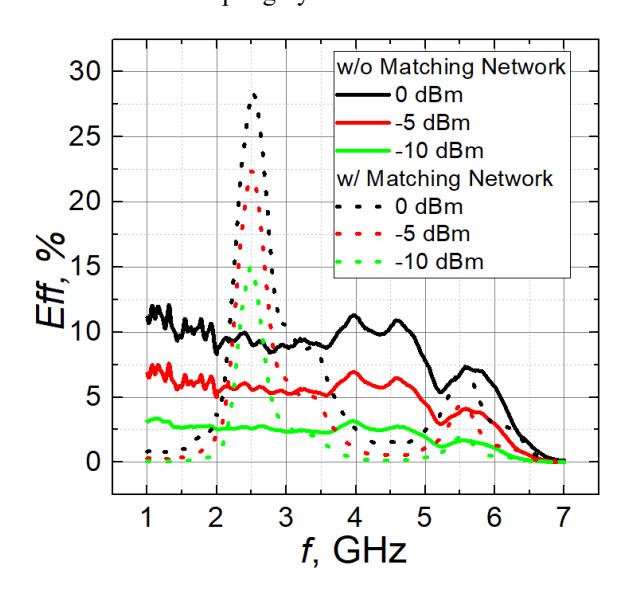
The rectifier transforms the power collected by antenna into DC current. We're considering a few rectifier topologies (Cockcroft, half-wave rectifier, full-wave rectifier) to find the most optimal variant between efficiency and power conversion. To ensure maximum power transfer, the impedance of antenna and rectifier is matched using an impedance matching network. Using RF generator, full-wave rectifier efficiency was measured when input power is 0 dBm, -5 dBm, and -10 dBm (Fig. 1). According to our results full-wave rectifier with matching network has efficiency of 14.4% at 2.4 GHz when input power is -10 dBm, which is low. Due to poor matching and losses in diodes efficiency at 5.5 GHz is even lower (0.19%).
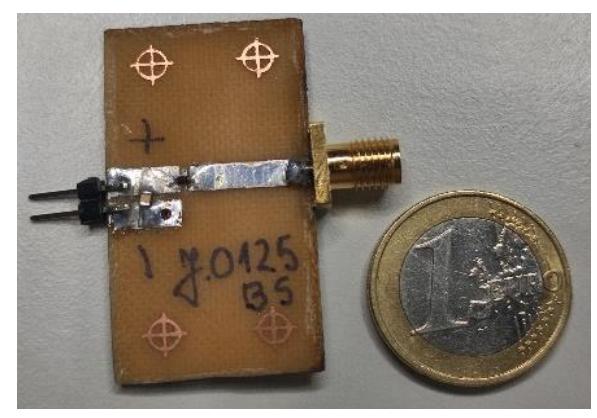
We think, that half-wave rectifier (Fig. 2) is a better solution for low power, because diodes are the major source of power loss and this topology uses only one. Half-wave rectifier will be investigated in our further work.
For power managing, we use the BQ25570 evaluation board. It can harvest microwatts of power from high impedance sources using the MPPT algorithm and has a regulated output to power a microcontroller. To store harvested power, we use a 1 F supercapacitor. In preliminary testing with a full-wave rectifier, we measure that our system can fully charge a supercapacitor (from 0 to 4 V) in 10 hours when the antenna is positioned 1 meter from the source and is fed by 20 dBm of power.
One day harvesting energy from the ambient sources will replace the need for batteries in low-power electronic devices. For now, our job is to find a way to make RF harvesting system more efficient and able to periodically power one sensor network.