The worldwide manufacturing of thermosets has been expanding in later years initiating fast usage of fossil-based feedstocks which contributes to the rise of plastic waste in the environment, particularly since they can not be effectively reprocessed or recycled at the end of their lifetime [1]. To solve this issue, scientists have been introducing dynamic cross-links which were capable of exchange reactions enabling rearrangement of the network, scratch repairing, self-healing, and reprocessability [2]. One class of such new dynamic materials discovered by French researcher Ludwik Leibler is vitrimers and they were termed since they flow like a vitreous silica (quartz glass) following the Arrhenius law [3]. At operating temperatures, they behave as permanently cross-linked polymers, however at elevated temperatures, the exchange reactions within their network speed up, making flow possible, while maintaining a constant number of chemical bonds and cross-links [4, 5]. Due to this behavior, vitrimers can be reshaped (shape memory polymers), repaired, and reprocessed by injection, extrusion or 3D printing [6]. Plenty structural and fast acting devices such as actuators for soft robotics which even could be repaired or reprocessed can be manufactured leading for sustainable development and environmental protection [7, 8].
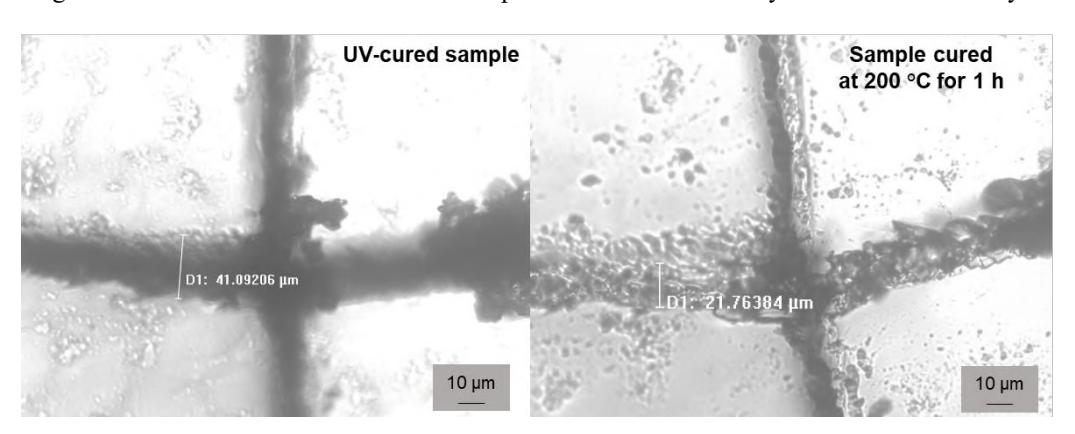
The aim of this work was to combine renewable resources, UV curing, and repairability as environmental friendly strategy for the synthesis of vitrimers. Therefore, two bio-based functionalized monomers obtained from vegetable oil and from glycerol, as a by-product of biodiesel, were chosen for preparation of UV-curable resins. Vitrimers were synthesized by mixing the monomers at different ratios with photoinitiator and transesterification catalyst and applying irradation under solvent-free condition. After UV curing, the dynamic networks were able to rapidly undergo thermo-activated rearrangements of their network topology as stress relaxation experiments performed on a MCR302 rheometer from Anton Paar showed. To verify repairability the scratch repairing tests were performed by scrathing the UV-cured vitrimer sample by a razor blade and curing at 200 °C for 1 h and monitoring by optical microscope Olympus BX41. All vitrimer samples showed a self-healing efficiency of more than 45% (Fig. 1) due to the sufficient hydroxyl and ester groups. The designed resins from renewable resources are potential candidates for synthesis of vitrimers by UV curing.