Anthocyanins (ANC), classified as flavonoids, possess some bioactive properties, such as antioxidant activity [1], though these compounds have low stability at elevated temperatures, varying pH and exposure to light, which limits their application. ANC are cationic compounds and could form complexes with biopolymers having oppositely charged groups, such as pectin (PEC). The stability of ANC could be improved through formation of water insoluble complexes e.g. by exploiting adsorption process. Since PEC is soluble in water, before adsorption process it has to be modified to reduce solubility. Cross-linking is one of the ways to obtain insoluble polymers and for this purpose cross-linkers such as epichlorohydrin can be used [2].
The aim of the present work was to investigate the formation of insoluble complexes between ANC present in aqueous wild bilberry extract and cross-linked PEC by evaluating kinetic and equilibrium adsorption of ANC on PEC0.05 powder.
Since PEC is soluble in water, it was cross-linked with epichlorohydrin in alkaline medium, to obtain insoluble PEC with a low cross-linking degree. The degree of cross-linking was expressed as the molar ratio of epichlorohydrin to PEC being equal to 0.05:1. Obtained cross-linked PEC was denoted as PEC0.05.
For the kinetic studies aqueous ANC extract was added to the flask with PEC0.05 powder and shaken at a constant rate and temperature of 30 °C. Residual concentration of ANC was determined after certain time intervals and the amount of adsorbed ANC was calculated ($q_e$ (mmol/g)). The obtained kinetic data were fitted by using the pseudo-second order kinetic model. Kinetic curves showed that adsorption of ANC on PEC0.05 powder proceeded quickly during the first 10 min and reached equilibrium after 2 hours.
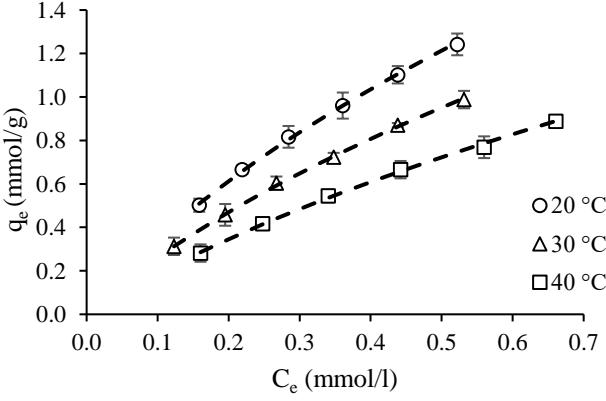
Equilibrium adsorption of ANC on PEC0.05 powder was studied at temperatures of 20 °C, 30 °C and 40 °C keeping the samples for 120 min. The Dubinin-Radushkevich, Freundlich and Langmuir adsorption models were used to describe obtained adsorption isotherms. Obtained adsorption isotherms showed (see Fig.1) that with an increase in the adsorption temperature the amount of ANC adsorbed onto PEC0.05 powder decreased. Based on the values of linear regression coefficient $R^2$, Dubinin-Radushkevich adsorption model fitted experimental data the best. It was demonstrated, that adsorption takes place due to electrostatic interactions between the flavylium cation of ANC and the ionized carboxyl groups of PEC0.05.