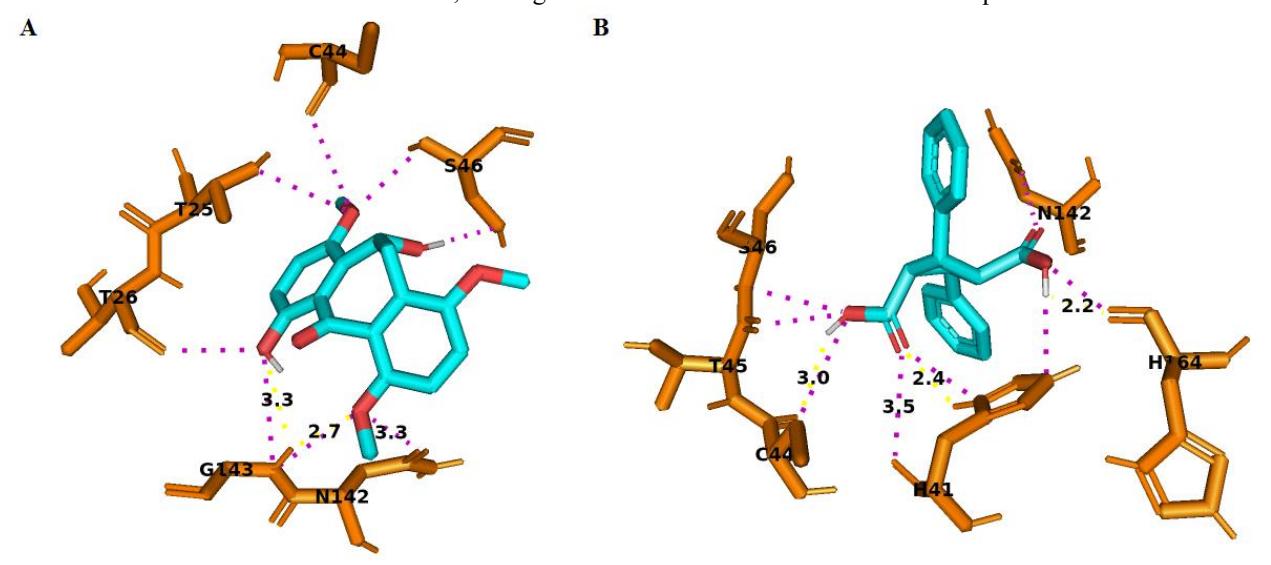
Main protease (Mpro), also known as 3CL protease, is a cysteine protease that plays a key role in the maturation of functional polypeptides involved in the replication-transcription mechanism assembly. Furthermore, Mpro has no human homologue and is highly conserved in all coronaviruses, making it a great antiviral target. A variety of plant compounds have been investigated for their natural antiviral properties and a review of the literature revealed that the phytochemicals onosmone and truxilic acid, which are found in the Indian medicinal plants Onosma echioides and Erythroxylum coca, had a weighted quantitative estimate of drug-likeness (QEDw) score $\geq$0.9 and were categorized as the most druggable phytochemicals by Mohanraj et al. (2018) [1]. The objective of this research was to simulate and predict structural interactions of onosmone and truxillic acid against the SARS-CoV-2 main protease and determine their potential antiviral activity. The three-dimensional crystal structure of Mpro (PDB ID: 6Y84) was retrieved from Protein Data Bank in PDB format and the preparation was performed using AutoDock Tools 1.5.6 [2], where the target protein was converted from PDB to PDBQT format. Also, using AutoDock Tools 1.5.6 we defined a gridbox with which we tried to capture the oxyanion hole (Cys145, Gly143 and Ser144) and the catalytic dyad (Cys145 - His41), which is a highly conserved area that serves as an active site. The three-dimensional structures of the two selected compounds, onosmone (CID: 102212116) and truxillic acid (CID: 78213), and positive controls were retrieved from PubChem in the SDF format and then converted to the PDBQT format using OpenBabel 3.1.1 [3]. As positive controls of binding affinity we used rutin (CID: 5280805) and remdesivir (CID: 121304016) due to their proven antiviral activity in previous studies. Molecular docking was performed using AutoDock Vina 1.1.2 [4], while the results were visualized using Pymol 2.5.2 [5]. After analyzing the structural interactions of onosmone and truxillic acid against Mpro, it was shown that both compounds interact with Mpro in its active site. Onosmone reacted with Thr25, Thr26, Cys44, Ser46, Asn142 and Gly143, forming two good (yellow) hydrogen bonds with Gly143 (2.7 Å and 3.3 Å) (Fig. 1A), with a binding affinity for Mpro at -7.1 kcal/mol, while truxillic acid reacted with His41, Cys44, Thr45, Ser46, Asn 142 and His164, forming three good (yellow) hydrogen bonds with His41 (2.4 Å), Cys44 (3.0 Å) and His164 (2.2 Å) (Fig. 1B), with a binding affinity at -6.7 kcal/mol. These findings indicate that these two compounds could be potentially antiviral and utilized as a treatment for COVID-19, although more in vitro and in vivo research is required.