
Optical parametric generation (OPG) of subnanosecond pulses is a challenge due to the following restrictions: 1) the laser induced damage threshold is close to the generation threshold; 2) the synchronous pump configuration cannot be applied in the case of low repetition rate of the order of 1 kHz.
In the present work we present the results of the numerical simulations of the OPG and optical parametric amplification (OPA) in periodically poled lithium niobate (PPLN) crystal pumped by a subnanosecond laser pulses. The simulation parameters are based on the performed experiments with a 2 cm long crystal that will be presented elsewhere. The duration of a Gaussian pump pulse was 470 ps, the input energy was varied from 10 to 100 μJ, beam diameter was 160 μm.
Signal spectra for 8 different grating periods were calculated from phase-matching condition using temperature-dependent Sellmeier equation [1]. For OPG, output signal spectrum and output signal power were calculated according to formalism developed in [2]. The resulting spectra at T = 60 °C are presented in figure 1 (solid lines). As we can see, the spectra become broader with increase of signal wavelength.
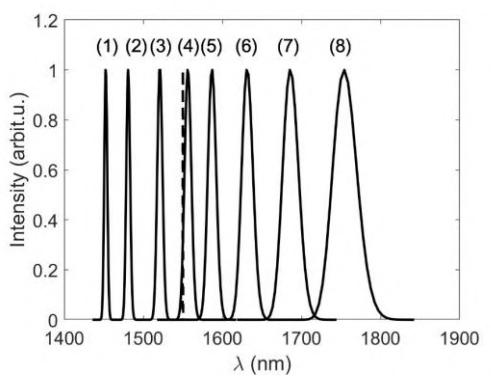
Temperature tuning was achieved for all 8 gratings. The simulations showed that conversion efficiency is larger at larger grating period and effective generation starts at pump energy of about 30 μJ for longer grating period and at around 40 μJ for shorter gratings.
For OPA, three-wave interaction model including dispersion terms was implemented. As in experiment, the seed of a laser diode operating in a continuous wave (cw) mode at 1550 nm wavelength was used. In contrast to OPA, in OPG the signal generation starts from the quantum noise. In OPA, the presence of the coherent light as a seed reduces the observed generation threshold. The spectrum width reduces, too, see figure 1, dashed line.