
In recent decades the diffraction grating has become an essential component of many optical systems and devices, for example, spectrometers [1]. What is more, their manufacturing technologies such as different replication methods including nanoimprinting and soft lithography are widespread [2], thus opening up the possibilities for their mass production. However, diffraction efficiency of diffraction gratings depends on many factors, such as grating period, height, filling factor, materials used and other parameters [3]. Moreover, grating geometry can be optimized for best performance under defined spectral illumination conditions [4]. Numerical methods, like those based on finite differences or Fourier expansion [5] are frequently used as powerful tools for rigorous diffraction efficiency estimation of gratings at the pre-production stage. An example of the idealized grating structure unit cell visualization used for Finite-Difference Frequency-Domain (FDFD) is depicted figure 1
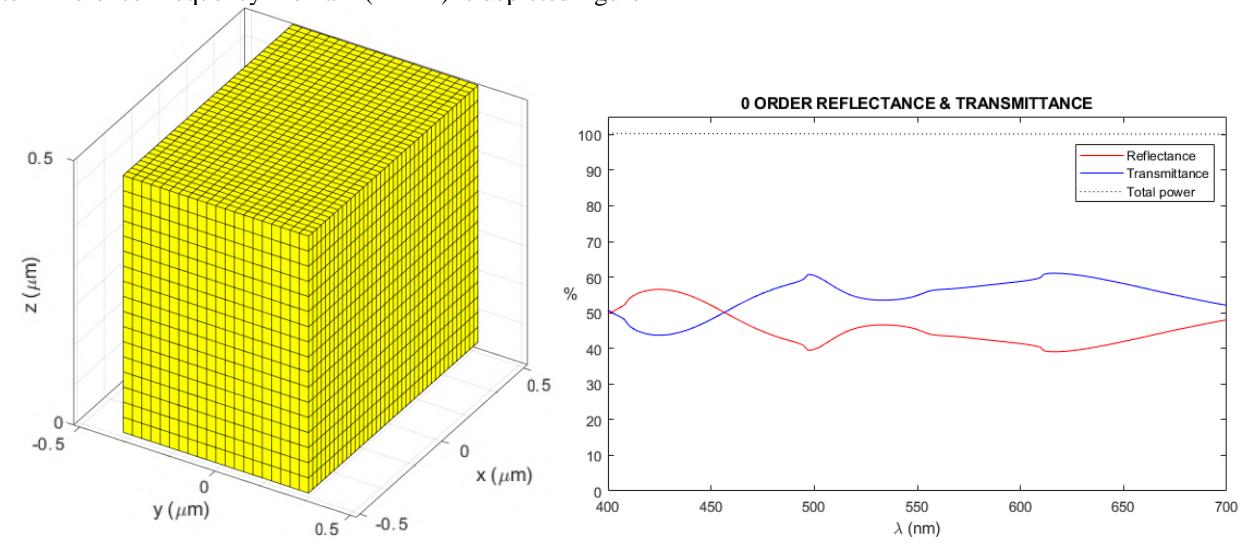
In this work, the dependence of relative diffraction efficiency on diffraction grating height, period, and filing factor is determined employing numerical methods implemented in MATLAB. Diffraction efficiency is estimated for different light polarizations and angles of incidence as well as wavelengths in the visible range (400 nm – 700 nm). FDFD formulation of the Slice Absorption Method was used to compute diffraction efficiency [6]. The optimized grating structures are going to be used for realization of dot matrix holograms.