
Observation and analysis of pulsar radiation give us possibilities both to study our Universe and to perform various tests of theories of gravity. The studying of the Galactic Center (Sgr A*) for many years provides information about of the pulsars that are on tight orbits around the supermassive black hole (see, e. g., [1]). This allows us to perform study of gravity in a strong field regime. Some theoretical approaches of reconstruction of a compact object motion that moves in the field of a supermassive black hole are presented in many papers (see, e. g., [2, 3]).
Most of this works, that consider the general case of orientation of the orbit, use the post-Newtonian expansion of the arrival time of the pulse, to perform calculations (see, e. g., [4, 5, 6]). Our approach is based on full general relativistic treatment of the problem of calculating of time dilation. The presented formalism gives us possibilities to obtain the analytical expression for the pulses time of arrival in both cases: for the motion of a single point-like object and for the motion of a binary system in external gravitational field of a supermassive black hole.
Firstly, by using the tetrad formalism we infer the equations of motion of compact binary system in external gravitational field. Secondly, we obtain an general expression for the time dilation of the pulsar pulses under the assumption of the compactness of the system. And finally, we complete the calculation for the model binary system, that moves in external Schwarzschild field.
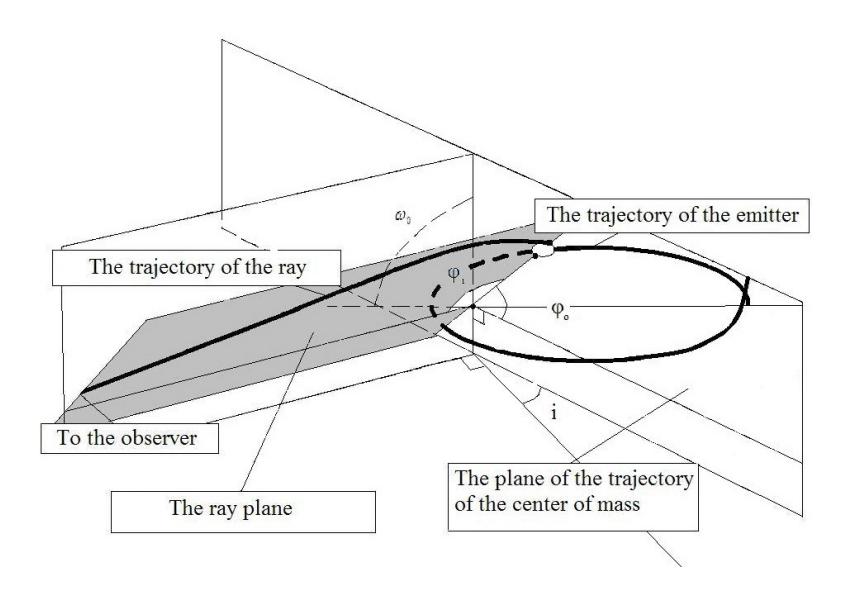
This approach without difficulties can be generalized on the case of Kerr, or Kerr-Newman supermassive black hole. By using the general expression for the time dilation that is discussed in our work, one can perform fitting of the time dilation data to reconstruct of the parameters of the motion (see Fig. 1) of the binary system near the Galactic Center.