
Turning waste rubber into a material, that could be reused has always proved to be a challenge. Reducing the particle size of end-of-life rubber products proved to be a promising path. Rubber that is reduced to crumb could be used as a filler while very fine rubber powder could even be incorporated into new rubber articles to a certain extent [1]. One of the methods of rubber powder production is cryogenic grinding, unfortunately due to the need of liquid nitrogen the process is not very cost efficient. Another way of rubber powder production is mechano-chemical treatment of rubber [2].
In our experiments we subjected truck tire buffings to mechanical shear in a two-roll mill (XSK-360, Wuxi Double Elephant Rubber and Plastic Machinery Co. Ltd., China) at certain processing conditions: without any additives (Sample 1); with the addition of 3% (w/w) of water (Sample 2); 3% (w/w) of water and 0.4 % (w/w) of NaCl (Sample 3); 3% (w/w) of water and 1 % (w/w) of acetamide (Sample 4); 3% (w/w) of water, 1% (w/w) of acetamide and 0.4% (w/w) of NaCl. All tribological conditions were kept constant during the experiments, processing temperature was ambient. After 16 processing cycles rubber samples were visually inspected and, if possible, the granulometric composition of processed rubber was determined (Figure 1A).
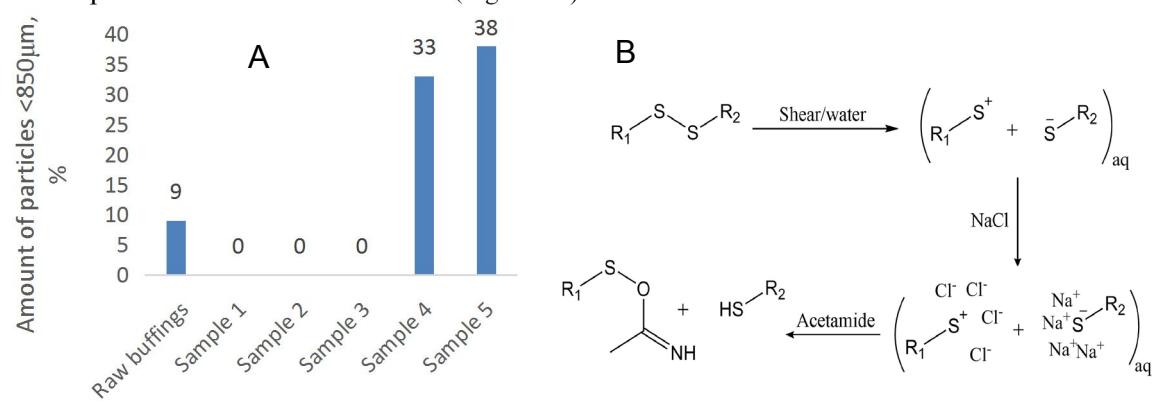
Rubber, due to it's structure, is a self-healing material at molecular level. When subjected to shear forces, weak cross-link bonds in the rubber matrix break and are able to recombine or react with adjacent polymeric chains, thus reforming a broken network. This could be illustrated by samples 1, 2 and 3 - rubber buffings, after being subjected to mechanical shear, started sticking together and forming a sponge like structure. It proved that neither water, nor NaCl alone could be used in mechano-chemical production of rubber powder. An interesting outcome was reached when acetamide was used as a chemical aid in mechno-chemical processing of rubber (sample 4) - the rubber particles not only did not stick together but were considerably reduced in size. This effect was increased even further when NaCl together with acetamide was added to the processing mixture. The action of acetamide and NaCl could be explained by suppression of rubber's self healing process: when rubber's cross-links break, they can break into charged species, instead of radicals as in thermal reclamation of rubber. These charged species could then react with acetamide, instead of polymeric chains, and thus be deactivated. The addition of NaCl helps in providing a shielding barrier between active charged species. Proposed mechanism is given in figure 1B.
When rubber's self healing process is suppressed by chemical aids, mechanical energy could be efficiently utilized in production of fine rubber powder by breaking down the rubber network. Another important conclusion, that could be drawn from the experiment, is that when rubber is subjected to moderate mechanical stress and polar environment [3], heterolytic, rather than homolytic, cleavage of bonds could be the dominant reaction.